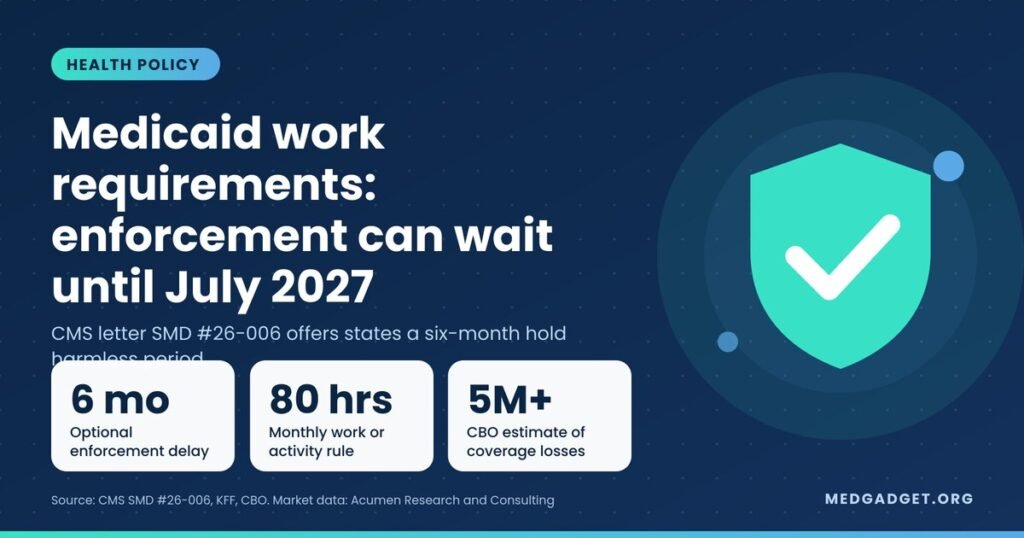

The Medicaid work requirements delay announced by the Centers for Medicare & Medicaid Services (CMS) on Friday, 13 November 2026, gives every state the option to hold off on denying or cutting Medicaid coverage for up to six months, through 30 June 2027, for people who cannot yet prove they meet the new 80-hours-a-month rule. The requirement itself still starts on 1 January 2027 under the 2025 federal budget reconciliation law, and states must tell CMS by 11 December 2026 whether they will use the new “hold harmless” period.
For the millions of adults covered through the Affordable Care Act Medicaid expansion, the practical question is simple: will my coverage end in January? For most people in states that take the option, the answer is now probably not, at least not for failing to file paperwork on time. Here is what changed, what did not, and what enrollees and providers should watch over the next four weeks.
Key takeaways on the Medicaid work requirements delay
- CMS issued State Medicaid Director letter SMD #26-006 on 13 November 2026 creating an optional six-month “hold harmless” period.
- During that window, through 30 June 2027, states may pause application denials and disenrollments for otherwise eligible people who have not shown they meet the requirement.
- The work requirement is not cancelled. States must still verify work, study, volunteering or an exemption, and keep building their systems.
- States must notify CMS of their choice by 11 December 2026. States that do nothing can begin enforcement on 1 January 2027.
- The rule covers expansion adults aged 18 to 64, who must show at least 80 hours a month of work or qualifying activities unless exempt.
- The Congressional Budget Office has estimated that more than 5 million enrollees would lose coverage under the policy.
What CMS actually changed
The new guidance does not move the statutory start date. Instead it softens the consequences of an imperfect launch. According to an analysis of the letter by KFF, states that opt in must still check whether each person meets the requirement or qualifies for an exclusion, but they can stop short of denying applications or terminating coverage when an otherwise eligible person has not demonstrated compliance.
That distinction matters because research on earlier work requirement experiments has consistently found that most enrollees either already work or would qualify for an exemption. Coverage losses tend to come from paperwork: missed notices, portals that do not work, or reporting rules people never hear about. The hold harmless period is aimed squarely at that failure mode.
CMS also tied the option to state compliance protections. Under the reconciliation law, states face greater financial risk if their eligibility error rates rise. States working within CMS-approved mitigation plans avoid formal compliance action and penalties linked to those errors, which had been a major worry for Medicaid agencies trying to stand up new verification systems in a matter of months.
Timeline: how the rule got here
| Date | Event |
|---|---|
| 3 June 2026 | CMS interim final rule on the Medicaid “community engagement” requirement published in the Federal Register |
| Late October 2026 | Federal judge in Boston strikes down the narrower “medical frailty” definition that required people with cancer and other chronic illnesses to prove they could not work |
| 11 November 2026 | Sen. Ron Wyden and Rep. Frank Pallone write to CMS Administrator Mehmet Oz seeking a delay |
| 13 November 2026 | CMS issues SMD #26-006 with the optional six-month hold harmless period |
| 11 December 2026 | Deadline for states to tell CMS whether they will use the option |
| 1 January 2027 | Statutory start date for work requirements nationwide |
| 30 June 2027 | Hold harmless period ends; full enforcement expected from July 2027 in opting states |
Who must meet the requirement, and who is exempt
The requirement applies to adults aged 18 to 64 enrolled through the ACA Medicaid expansion. They must document at least 80 hours a month of work, job training, education, volunteering or a combination. Exemptions in the law include people who are pregnant, people with serious illness or disability, people in treatment for substance use disorder and several other groups.
The medical frailty piece has shifted. After the October court ruling, CMS now says states only need to confirm that a person has a condition in one of the five statutory medical frailty categories. They do not need proof that the condition prevents work. For patients with cancer, serious mental illness or complex chronic disease, that is a meaningful reduction in paperwork, and hospitals and clinics will want to make sure diagnoses are documented in ways state systems can recognise.
Why states pushed for more time
Officials in both Democratic and Republican states had warned they were not on track for January. States have spent millions of dollars, in some cases tens of millions, on staff, eligibility databases and data-matching contracts. Virginia’s health secretary, Marvin Figueroa, told reporters he expects his state to take the delay, calling it “a recognition that the timeline was unrealistic.”
Congressional Democrats called the move a step in the right direction but not enough, and have pledged to try to repeal the requirement and related Medicaid cuts when they take control of Congress in 2027. That makes the hold harmless window politically significant as well: by our calculation, a state that opts in would not begin disenrolling people for non-compliance until July 2027, six months into a new Congress.
What it means for patients, hospitals and health plans
- Enrollees: In opting states, missing a report in early 2027 should not by itself end coverage. People should still respond to state notices and report hours or exemptions, because verification continues and the grace period ends on 30 June 2027.
- Hospitals and clinics: Fewer abrupt coverage losses in the first half of 2027 means less uncompensated care in the short term. Safety-net providers can use the window to help patients document exemptions.
- Medicaid managed care plans: Enrollment is likely to be steadier through mid-2027 in opting states, but plans should still prepare for churn once enforcement begins.
- States that decline: Enforcement, and the coverage losses that come with it, could begin as early as January.
The policy sits alongside other cost pressures in US health coverage, including debates about whether employers and public payers can afford new drug classes. Our recent look at the CVS GLP-1 study shows how payers are weighing those trade-offs. More coverage policy news is in our Healthcare Services section.
Market context
Medicaid is one piece of a very large public coverage system. According to Acumen Research and Consulting, the global health insurance market was valued at about USD 2.06 trillion in 2022 and is projected to reach USD 3.81 trillion by 2032, a compound annual growth rate of 6.5%. Acumen estimates that public providers held roughly 60% of the market in 2022, with North America the largest region. Those figures come from a 2023 report and predate the reconciliation law, so they are best read as background on scale rather than a forecast of Medicaid enrollment.
What to watch next
The key date is 11 December, when states must declare their choice. Watch whether large expansion states, and the states that sued over the rules, opt in. Watch also for any further litigation over exemptions, and for CMS guidance on how verification data collected during the grace period will be used once enforcement starts in July 2027.
FAQ
Are Medicaid work requirements delayed until 2027?
The requirement still begins on 1 January 2027. What CMS delayed is enforcement: states may choose not to deny or end coverage for non-compliance until 30 June 2027.
Will I lose Medicaid in January 2027?
If you are an expansion adult in a state that takes the hold harmless option, you should not lose coverage simply for not reporting hours before July 2027. If your state declines, enforcement can start in January. Check notices from your state Medicaid agency.
How many hours do you have to work for Medicaid?
At least 80 hours a month of work, job training, school, volunteering or a mix, for adults aged 18 to 64 in the expansion group, unless an exemption applies.
Which states will use the six-month delay?
States must decide by 11 December 2026. Virginia has signalled it expects to accept; other states have not yet publicly confirmed their choice.
Sources: CMS State Medicaid Director letter SMD #26-006 (13 November 2026) as summarised by KFF; Federal Register interim final rule (3 June 2026); Yahoo News and other contemporaneous reporting. Market data: Acumen Research and Consulting. This article is for information only and is not legal, medical or financial advice. Last updated 15 November 2026.