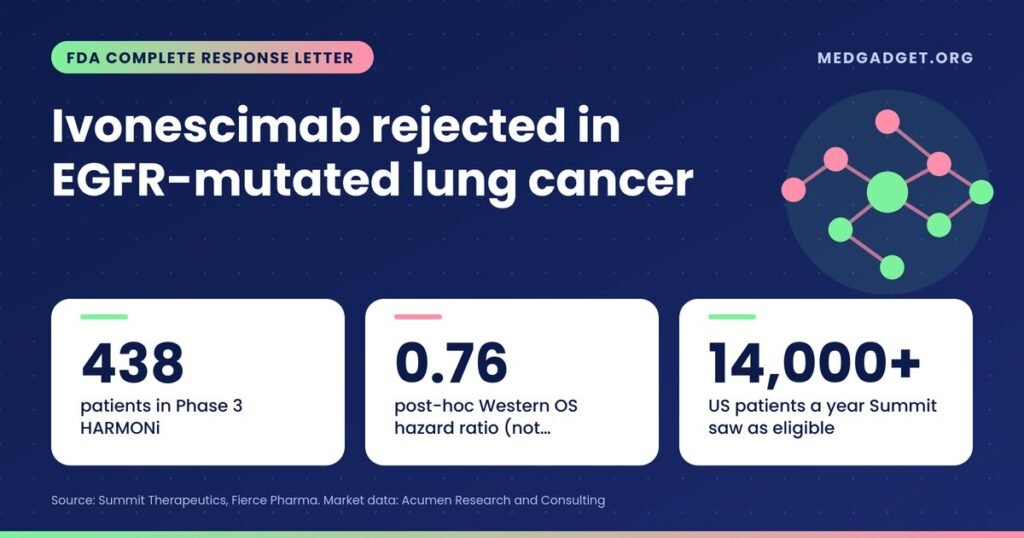

The ivonescimab FDA rejection landed on Sunday, November 15, 2026, when Summit Therapeutics said the agency had issued a Complete Response Letter for its PD-1 x VEGF bispecific antibody in EGFR-mutated non-small cell lung cancer (NSCLC). The FDA concluded that the Phase 3 HARMONi trial, which enrolled 438 patients, improved progression-free survival but did not deliver a statistically significant overall survival benefit, and that this was not enough to establish effectiveness. The decision keeps the first PD-1 x VEGF drug out of the US market, at least for now.
Key takeaways on the ivonescimab FDA rejection
- The FDA issued a Complete Response Letter for ivonescimab plus platinum chemotherapy in EGFR-mutated, non-squamous NSCLC after a third-generation EGFR TKI. The target action date was November 14, 2026.
- The agency said a progression-free survival benefit alone, without a significant overall survival gain, did not show a positive benefit-risk balance.
- Overall survival hazard ratios in HARMONi drifted from 0.79 to about 0.76 with longer follow-up, but none of the analyses reached statistical significance.
- Ivonescimab remains approved in China (via Akeso since May 2024) and Summit continues trials in lung, colorectal, bladder and kidney cancer, including HARMONi-3 and HARMONi-7.
- For US patients whose EGFR-mutated lung cancer progresses on osimertinib, chemotherapy-based regimens and amivantamab combinations remain the main options.
What the FDA said, in plain terms
According to Summit’s announcement, the FDA said the biologics license application cannot be approved in its present form. The agency’s reasoning had two parts. First, substantial evidence of effectiveness was not established because overall survival did not improve to a statistically significant degree. Second, the progression-free survival gain, on its own, did not indicate a favourable benefit-risk profile for this population.
That is a meaningful signal from the agency. In later-line lung cancer, where patients have already exhausted a targeted drug, the FDA has increasingly treated survival as the endpoint that matters most, especially when a new regimen adds toxicity on top of chemotherapy. Summit’s chairman and co-CEO Robert Duggan said the company was “disappointed for patients and their families awaiting additional treatment options in this setting.” The company did not set out a resubmission timeline for the EGFR indication.
HARMONi survival data across each analysis
The story of this application is a survival curve that kept improving but never crossed the statistical line. Summit updated the FDA several times, most recently with a June 2026 data cut. The table below brings the reported figures together.
| Analysis | Population | Overall survival HR | Median follow-up (Western) | Significant? |
|---|---|---|---|---|
| Primary, April 2025 | Full trial (438) | 0.79 | 9.2 months | No |
| Primary, April 2025 | Western (165) | 0.98 | 9.2 months | No |
| Update, Sept 2025 | Full trial | 0.78 | 13.7 months | No |
| Update, Sept 2025 | Western | 0.84 | 13.7 months | No |
| Post-hoc, June 2026 | Western | 0.76 | 23.2 months | No |
A hazard ratio of 0.76 means the point estimate for the risk of death was about 24% lower on ivonescimab, by our calculation. But the confidence interval still included no benefit, and the June 2026 Western figure came from a post-hoc look that was not part of the pre-specified plan. Regulators place far less weight on analyses chosen after the fact. The trial did meet its progression-free survival primary endpoint, which Summit describes as the first such win for an immunotherapy-based regimen after EGFR TKI failure.
Safety was not the sticking point
The rejection does not appear to rest on a new safety signal. In HARMONi, 7.3% of patients (16) on ivonescimab plus chemotherapy stopped treatment because of treatment-related side effects, compared with 5.0% (11) on placebo plus chemotherapy. Treatment-related deaths were 1.8% (4 patients) with ivonescimab and 2.3% (5 patients) with chemotherapy alone. The FDA’s issue, as described by Summit, was the strength of the efficacy evidence rather than the side-effect profile.
Why the PD-1 x VEGF class still matters
Ivonescimab binds PD-1, the immune checkpoint targeted by Keytruda, and VEGF, the blood-vessel growth signal targeted by Avastin, in one molecule. The idea is to release the brakes on T cells while starving the tumour of new blood supply. The drug drew enormous attention after beating Keytruda head-to-head in first-line PD-L1-positive NSCLC in a China-only trial, and the class has since attracted multibillion-dollar bets from large drugmakers. BioSpace reported that analysts had largely been optimistic before the decision, and that the overall PD-1 x VEGF market has been projected to reach tens of billions of dollars in the next decade.
This CRL is specific to one narrow, later-line setting. It does not rule on the first-line data, which still need confirmation in global populations. That confirmation is the job of HARMONi-3 and HARMONi-7. HARMONi-3 missed statistical significance on progression-free survival at an interim analysis in May 2026, so the coming readouts carry real weight for both Summit and its partner Akeso. We covered the build-up in our preview of the ivonescimab FDA decision.
Market context for lung cancer therapies
The commercial stakes explain why this decision drew so much attention. According to Acumen Research and Consulting, the global lung cancer market was valued at USD 21.1 billion in 2021 and is projected to reach USD 67.9 billion by 2030, a compound annual growth rate of 14.1%. Acumen expects Asia-Pacific to grow fastest, which matches where ivonescimab is already sold. Those estimates come from a report last updated in February 2023, so treat them as indicative rather than current.
What it means for patients and what comes next
Summit estimated that more than 14,000 US patients a year could have been eligible in this setting. For them, nothing changes today: treatment after osimertinib progression still centres on platinum chemotherapy, with or without amivantamab, and clinical trials. Patients interested in PD-1 x VEGF drugs can ask their oncologist about enrolling in ongoing studies.
Things to watch next: whether Summit seeks a meeting with the FDA to discuss a path for the EGFR indication, the timing of HARMONi-3 survival data, and how rival PD-1 x VEGF programmes design their trials now that the FDA has signalled it wants survival proof in this kind of setting. For more oncology regulatory coverage, see our Pharmaceutical news section and our report on the Optune Mya not-approvable letter.
FAQ
Why did the FDA reject ivonescimab?
The FDA said HARMONi did not show a statistically significant overall survival benefit, and that the progression-free survival improvement alone did not demonstrate a positive benefit-risk profile in EGFR-mutated NSCLC after TKI therapy.
Is ivonescimab approved anywhere?
Yes. Akeso’s ivonescimab has been approved in China since May 2024. It is not approved in the United States or Europe.
Can Summit still get ivonescimab approved in the US?
Possibly, but not on the current HARMONi package as submitted. A future application could rely on new trials such as HARMONi-3 or HARMONi-7, or on additional survival evidence the FDA accepts. Summit has not announced a timeline.
Is ivonescimab better than Keytruda?
It outperformed Keytruda on progression-free survival in one first-line trial run only in China. Whether that holds in global populations, and whether it translates into longer survival, has not yet been shown.
Sources: Summit Therapeutics press release (15 Nov 2026), BioSpace, Fierce Pharma, CURE. Market data: Acumen Research and Consulting, Lung Cancer Market report. This article is for information only and is not medical or investment advice. Last updated: 15 November 2026.