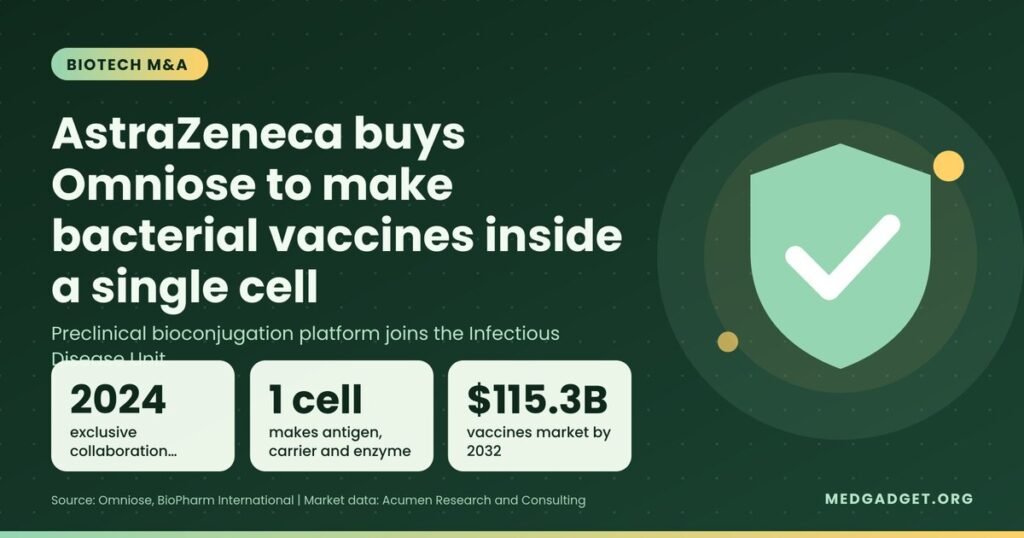

The AstraZeneca Omniose acquisition, announced on November 10, 2026, brings a St. Louis start-up that makes conjugate vaccines inside a single engineered E. coli cell into AstraZeneca’s Infectious Disease Unit as a wholly owned subsidiary. Terms were not disclosed. The deal converts a research collaboration that began in January 2024 into outright ownership, and it signals that AstraZeneca wants its own route into bacterial vaccines, a field long dominated by chemically made products such as pneumococcal and meningococcal shots.
Key takeaways on the AstraZeneca Omniose acquisition
- AstraZeneca bought Omniose outright; the price was not disclosed.
- Omniose’s platform builds polysaccharide-protein conjugate vaccines biologically, inside one bacterial cell, instead of joining parts chemically in a factory.
- The two companies had an exclusive research tie-up since January 2024 covering bacterial vaccine candidates.
- All programs are preclinical. NIH grants have funded Omniose work on Klebsiella pneumoniae and Group B Streptococcus vaccines.
- No clinical, yield or cost data have been published, so the manufacturing advantage is still a claim to be proven.
The problem Omniose is trying to solve
Many dangerous bacteria hide behind a sugar coat called a capsular polysaccharide. Sugars alone trigger weak immunity, especially in infants. Conjugate vaccines fix that by attaching the sugar to a carrier protein so the immune system builds lasting, T-cell supported memory. The approach underpins some of the most successful vaccines in history, against Haemophilus influenzae type b, pneumococcus and meningococcus.
The catch is manufacturing. Today’s conjugates are typically made by growing the pathogen, purifying its polysaccharide, preparing a carrier protein separately, chemically linking the two, and purifying again. Each serotype in a multi-valent pneumococcal vaccine goes through its own version of that chain, which is a major reason these products are expensive and slow to expand.
Chemical conjugation vs Omniose bioconjugation
| Step | Conventional chemical conjugate | Omniose bioconjugation |
|---|---|---|
| Polysaccharide source | Grown in and purified from the pathogen | Made by engineered E. coli |
| Carrier protein | Produced and purified separately | Made in the same E. coli cell |
| Linking | Chemical reaction in a separate step | Enzyme joins them inside the cell |
| Purification rounds | Several | Fewer claimed; not yet published |
| Track record | Multiple licensed vaccines | Preclinical only |
Omniose says the single-cell route is simpler and more precise and can attach virtually any bacterial polysaccharide to engineered carriers. BioPharm International notes that published data do not yet back that breadth claim. Academic reviews of the field point to two known hurdles: the most widely used coupling enzyme does not handle most pneumococcal capsule types, and forcing E. coli to make foreign sugars can strain the host cell. Whether Omniose has engineered around those limits is the central technical question.
Deal timeline
- 2022: Omniose receives NIH/NIAID funding of up to $3.6 million for a Klebsiella pneumoniae vaccine.
- 2023: A further NIH award of up to $3.0 million supports a Group B Streptococcus vaccine.
- January 2024: AstraZeneca signs an exclusive research collaboration giving it platform rights for up to three years.
- November 10, 2026: AstraZeneca acquires the company as the collaboration window closes.
Benjamin Moutier, AstraZeneca’s head of infectious disease, said the platform “strengthens our ability to develop novel vaccines against serious bacterial infections,” according to the Omniose announcement. Chief executive Timothy Cooke and co-founder Christian Harding lead the company.
Why the targets matter
Klebsiella pneumoniae is a leading cause of hospital infections and one of the pathogens most associated with carbapenem resistance, and there is no licensed vaccine. Group B Streptococcus causes sepsis and meningitis in newborns, and a maternal vaccine has been a long-standing public health goal. Both organisms carry many capsule types, the exact situation where a cheaper, faster way to make multi-valent conjugates would pay off. For context on how infectious disease is reshaping policy, see our report on New York’s first measles-associated child death in decades.
Market context
Acumen Research and Consulting sizes the global vaccines market at USD 59.4 billion in 2023, rising to USD 115.3 billion by 2032 at a 7.8% CAGR. By our calculation that is close to a doubling. Acumen identifies conjugate vaccines as the largest technology segment, citing longer-lasting protection and better performance in infants, and expects pneumococcal vaccines to hold a significant share. The report page carries an older last-updated date, so the figures are best read as indicative.
What remains unknown
- The purchase price and any milestone payments.
- Which pathogens AstraZeneca will prioritise and when a first candidate could enter human trials.
- Yield, purity and cost data comparing bioconjugates with chemical conjugates at commercial scale.
The deal fits a broader pattern of large drugmakers buying platforms rather than single assets, as seen in recent moves covered on our biotechnology pages and in AstraZeneca’s wider pipeline news such as its gastric cancer trial readout.
FAQ
How much did AstraZeneca pay for Omniose?
Neither company disclosed the financial terms.
What is a bioconjugate vaccine?
A conjugate vaccine whose sugar antigen and carrier protein are produced and linked by an engineered microbe using enzymes, rather than joined chemically after separate production.
Does Omniose have a vaccine in human trials?
No. All announced programs are preclinical.
Where is Omniose based?
St. Louis, Missouri. It now operates as a subsidiary inside AstraZeneca’s Infectious Disease Unit.
Sources: Omniose announcement via Business Wire (November 10, 2026); BioPharm International; NIH grant announcements. Market data: Acumen Research and Consulting, Vaccines Market report. Not medical or investment advice. Last updated: November 12, 2026.