
The Zolgensma cancer risk moved from a theoretical label warning to a confirmed safety signal on November 6, 2026, when the US Food and Drug Administration said it is investigating tumors in children treated with Novartis’s one-time gene therapy for spinal muscular atrophy (SMA). The agency confirmed that in two patients the therapy’s viral vector DNA inserted itself next to or inside GLI1, a known cancer gene, and it extended the review to Itvisma, the newer spinal-injection version of the same treatment. The FDA still says the benefits outweigh the risks, and it has not ordered any change in use.
Key takeaways on Zolgensma cancer risk
- The FDA issued a safety communication on November 6, 2026, after postmarketing reports of tumors in Zolgensma-treated patients.
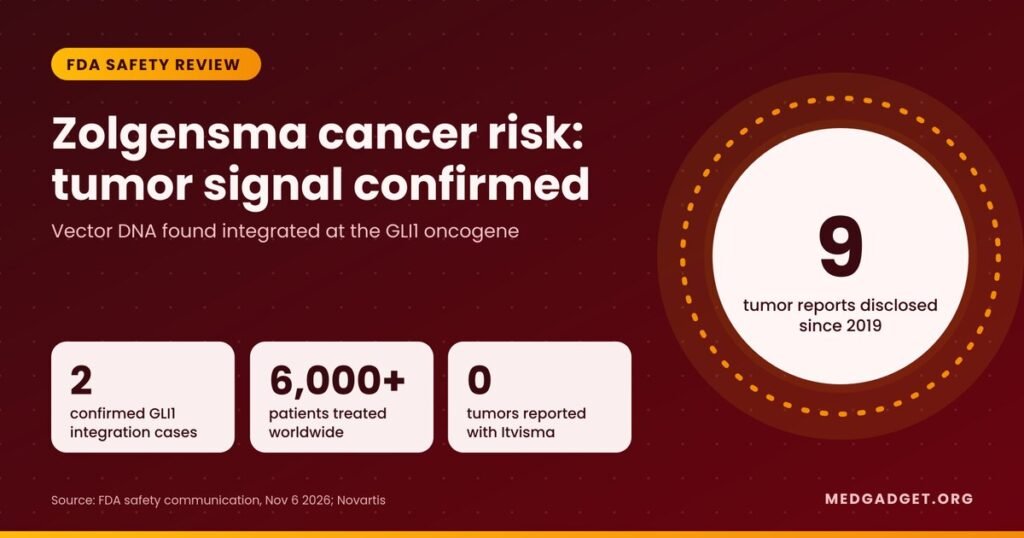
- Novartis disclosed nine tumor reports a day earlier, according to trade press coverage of the company’s statement.
- Three tumors involved the GLI1 oncogene; in two, lab analysis found the vector’s promoter integrated upstream of or within the gene (insertional oncogenesis).
- Reported tumors affected the brain and nerves, the spinal and paraspinal region, and the kidney.
- Itvisma is included because it uses the same AAV9 vector and gene construct, although no tumors have been reported with it.
- No recall or treatment pause: FDA asks clinicians to monitor treated patients for tumors and report any cases.
What the FDA actually found
Zolgensma (onasemnogene abeparvovec) delivers a working copy of the SMN1 gene using an adeno-associated virus serotype 9 (AAV9) shell. AAV vectors were long considered low-risk for cancer because their DNA mostly stays outside the host chromosomes. The prescribing information has nevertheless carried a warning about a “theoretical risk of tumorigenicity” from vector integration since approval in May 2019.
The FDA safety communication changes that picture. Tumor tissue from two children showed Zolgensma vector DNA stitched into the genome with its promoter sitting upstream of or within GLI1, a gene that can drive tumor growth when switched on abnormally. A third GLI1-associated tumor is still being studied to work out how the gene was activated. The agency did not publish a total count of tumor reports, patient ages or the time between infusion and diagnosis.
The numbers so far
| Item | Detail |
|---|---|
| FDA safety communication | November 6, 2026 (CBER) |
| Tumor reports disclosed by Novartis | 9 since 2019 approval (company statement, November 5) |
| GLI1-associated tumors | 3 |
| Confirmed vector integration at GLI1 | 2 |
| Patients treated worldwide | More than 6,000 (trials, managed access, commercial), per Novartis |
| Tumor sites reported | Central and peripheral nervous system, spinal/paraspinal, kidney |
| Itvisma tumor reports | None to date |
By our calculation, nine reports among roughly 6,000 treated patients is about 0.15%, or one report per 667 patients, and the two confirmed integration cases equal about 0.03%. Treat those figures with caution. Spontaneous reports undercount events, many children have only a few years of follow-up, and published latency for AAV-linked tumors runs from about two to more than four years, so the true rate is not yet knowable.
Why this matters beyond one product
The FDA tied its review to two 2026 papers in the New England Journal of Medicine. One described a paraspinal tumor 26 months after FBX-101, an AAV gene therapy given to a child with Krabbe disease, again with vector integration driving GLI1. The other reported a neuroepithelial tumor about four years after AAV9 was delivered into the cisterna magna in a child with MPS I (the RGX-111 program), this time with integration into PLAG1.
Three separate programs, two different oncogenes and a shared vector family suggest the issue is a class question for high-dose AAV in young children, not a quirk of one manufacturing process. That is why the agency says it is watching similar AAV programs. For developers, the likely consequences are longer follow-up, integration-site testing on any tumor that appears, and closer scrutiny of promoters that are strong enough to switch on neighboring genes. Readers following the field will see the contrast with ex vivo editing approaches such as Beam’s risto-cel base-editing therapy for sickle cell disease, which carries its own, different safety questions.
What families and clinicians are being told
- Keep the benefit in view. FDA states that “the overall benefits of Zolgensma and Itvisma continue to outweigh their potential risks for their approved uses.” Untreated severe SMA is often fatal in infancy.
- Monitor for tumors. Patients and trial participants who received either product should be monitored for tumor formation. FDA has not set a scan schedule, so families should ask their neuromuscular team what follow-up suits their child.
- Report new tumors. Cases go to Novartis Gene Therapies (1-833-828-3947) or FDA MedWatch (1-800-FDA-1088).
- Labeling under review. FDA is assessing whether the current warning and Novartis’s long-term follow-up studies are adequate and whether regulatory action is needed.
Families weighing SMA options can also compare oral and injected alternatives; our report on Natco’s generic risdiplam covers how cheaper chronic therapy is changing access in India.
Market context: vector manufacturing at a crossroads
The safety signal lands on a fast-growing supply chain. According to Acumen Research and Consulting, the viral vector and plasmid DNA manufacturing market was worth USD 5.4 billion in 2023 and is projected to reach USD 24.6 billion by 2032, an 18.5% compound annual growth rate. If regulators ask for integration-site analysis and longer surveillance, part of that spend may shift toward analytics, vector engineering and safer promoter design rather than raw capacity.
Open questions to watch
- Whether risk varies with dose, age at infusion or route (intravenous Zolgensma versus intrathecal Itvisma).
- Whether FDA upgrades the theoretical warning to a described risk, or adds a boxed warning or required imaging schedule.
- How the European Medicines Agency and other regulators respond.
- Whether Novartis publishes the nine cases with ages, tumor types and outcomes. The company has said the two confirmed patients were treated and remain under follow-up. Novartis’s recent pipeline pressures are covered in our Novartis Q3 2026 analysis.
FAQ
Does Zolgensma cause cancer?
FDA has confirmed that in two patients the therapy’s vector DNA integrated next to the GLI1 cancer gene and was linked to tumor development. Causation in other reported cases has not been established, and the overall rate appears low based on current reports.
Should my child who received Zolgensma stop treatment or be retested?
Zolgensma is a one-time infusion, so there is nothing to stop. FDA advises ongoing monitoring for tumors; ask your child’s neurologist what imaging or checks make sense.
Is Itvisma affected by the FDA investigation?
Yes. FDA applies the potential risk to Itvisma because it shares Zolgensma’s vector and construct, although no tumors have been reported after Itvisma to date.
Has FDA pulled Zolgensma from the market?
No. FDA says benefits still outweigh risks for approved uses and is evaluating whether labeling changes or other action are needed.
Sources: FDA safety communication (November 6, 2026); Novartis statements as reported in trade press; NEJM 2026 case reports cited by FDA. Market data: Acumen Research and Consulting. More in Bio Technology. This article is for information only and is not medical or investment advice. Last updated: November 12, 2026.