
Peptide synthesis capacity is a technical subject that rarely makes headlines, yet it determines whether a peptide drug can be made reliably at scale. In early November 2026, Shilpa CDMO announced a $50 million, phased expansion at its Raichur site in Karnataka, with a first commercial line planned for December 2026. This article explains the chemistry behind that capacity, the differences between solid-phase, liquid-phase and hybrid routes, and what the announcement does and does not tell us about readiness.
Key takeaways on peptide synthesis capacity in the Shilpa announcement
- The first commercial line is planned for December 2026; it is not yet operating.
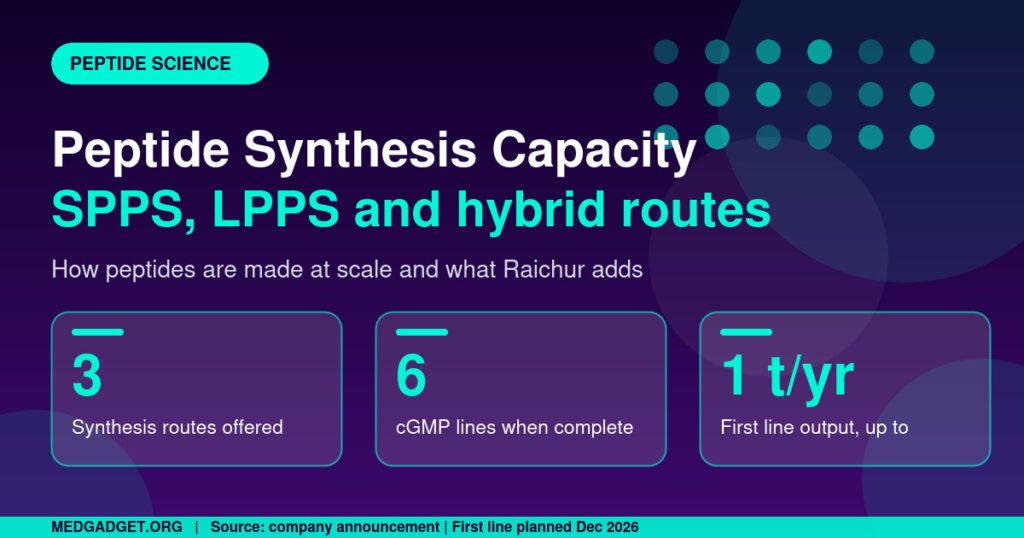
- Reactor capacity added totals 10 kL of solid-phase synthesis; the first line has 500 L and 1,000 L reactors with output up to about 1 metric tonne a year.
- The company says it will offer solid-phase (SPPS), liquid-phase (LPPS) and hybrid routes for linear, cyclic and branched peptides.
- Purification includes dynamic axial compression columns, preparative HPLC, nanofiltration and lyophilisation.
- No customers or volumes have been named.
How a peptide is built
A peptide is a chain of amino acids joined by peptide bonds. In solid-phase peptide synthesis, the first amino acid is anchored to a solid resin and the chain is extended one residue at a time, with washing steps between each addition. When the chain is complete it is cleaved from the resin. SPPS is efficient and automatable for peptides of modest length, but errors accumulate with each step, so very long peptides become harder to make with high purity.
In liquid-phase synthesis, fragments are made in solution and then joined. This can be better suited to large volumes and longer sequences, but requires careful purification of intermediates. A hybrid route combines the two, making fragments by SPPS and joining them in solution. Dipak Kalita of Shilpa CDMO said that for longer peptides a hybrid fragment-based route can become the sensible choice as volumes grow.
| Route | General idea | Typical fit (general, not company-specific) |
|---|---|---|
| SPPS | Stepwise build on a resin | Shorter peptides, flexible, automatable |
| LPPS | Fragments made and joined in solution | Larger volumes, some longer sequences |
| Hybrid | Fragments by SPPS, joined in solution | Longer peptides as volumes grow |
Why purification is the bottleneck
Making the crude peptide is only part of the job. It must be purified to remove truncated and modified sequences, typically by preparative chromatography, then concentrated and dried. The first line includes two 2-metre dynamic axial compression columns, a preparative HPLC system rated at 10,000 litres an hour, nanofiltration at 1,000 litres an hour and a 1,000-litre lyophiliser, according to the company. Purification capacity often limits how much usable peptide a plant can deliver, which is why the equipment list matters as much as reactor volume.
What cGMP means for peptides
Current good manufacturing practice is the quality framework regulators require for medicines. It covers documentation, equipment, personnel, cleaning and testing. The US FDA publishes its cGMP regulations online, and India’s regulator is the Central Drugs Standard Control Organisation. The company says it will have six parallel cGMP lines when complete, including one for cytotoxic peptides, which need containment to protect staff and prevent cross-contamination. Inspection status for the new line was not stated.
Process control and analytics
The company says the plant uses a centralised distributed control system, integrated process analytical technology with ultraviolet monitoring, and design of experiments with process simulation. These tools help detect deviations early and understand how process settings affect purity and yield, but the announcement gives no performance data such as yield or purity.
Timeline
- Early November 2026: $50 million investment announced.
- December 2026: first commercial line planned.
- Through 2027: commercial supply expected to ramp.
- Later phases: 2 kL, 3 kL and 5 kL reactors planned without dates.
Market context: peptide synthesis
Acumen Research And Consulting’s Peptide Synthesis Market report gives USD 597.3 million in 2023 and USD 1,173.0 million by 2032, a compound annual growth rate of 7.9% for 2024 to 2032. Reagents and consumables held 47% of 2023 revenue and therapeutics about 69%. North America accounted for about USD 226.9 million and Asia-Pacific is projected to grow at more than 8.6%.
The page carries a last-updated date of 2019, has an FAQ with an older and conflicting forecast and contains several garbled statements, such as an implausible claim about natural peptides. We therefore treat it as indicative only. It also covers research reagents and not only commercial manufacturing, so it understates the size of the drug-manufacturing opportunity if anything.
Our analysis
In our assessment, the technical choices described are sensible for the market the company is targeting: multiple synthesis routes, high-capacity purification and a containment line. They do not, however, show that the plant works at scale. Evidence of readiness would be inspection outcomes, batch records and customer contracts, none of which has been reported. The December 2026 start is a plan.
What is not disclosed
- Yield, purity and batch performance data.
- Regulatory inspection status.
- Customers and volumes.
- Dates for later reactors.
Risks and caveats
- The first line is planned and not yet operating.
- Capacity claims are the company’s own.
- Market statistics are dated and inconsistent.
- This article is not investment advice.
What to watch next
- Start of commercial production.
- Regulatory inspections.
- Customer announcements.
- Progress on the larger reactors.
General background
Related coverage: Laurus Labs’ peptide and oligonucleotide capabilities and the Galenvs acquisition. More in the Pharmaceutical category.
Questions readers are asking about peptide synthesis capacity
What limits peptide output?
Often purification capacity as much as reactor size.
Why use a hybrid route?
For longer peptides at larger volumes, fragment-based routes can be more practical, according to the company.
Is the new capacity operating?
No. The first commercial line is planned for December 2026.
FAQ
What is lyophilisation?
Freeze-drying, used to turn a purified peptide solution into a stable powder.
What is a cytotoxic peptide?
A peptide that kills cells, used in some cancer therapies, which requires containment in manufacturing.
What is HPLC?
High-performance liquid chromatography, used to separate and purify compounds.
How we reported this: details come from Shilpa CDMO’s announcement in early November 2026 as reported in trade press; market figures are attributed to Acumen Research And Consulting. Last updated 4 November 2026. This is news reporting and not investment or medical advice.