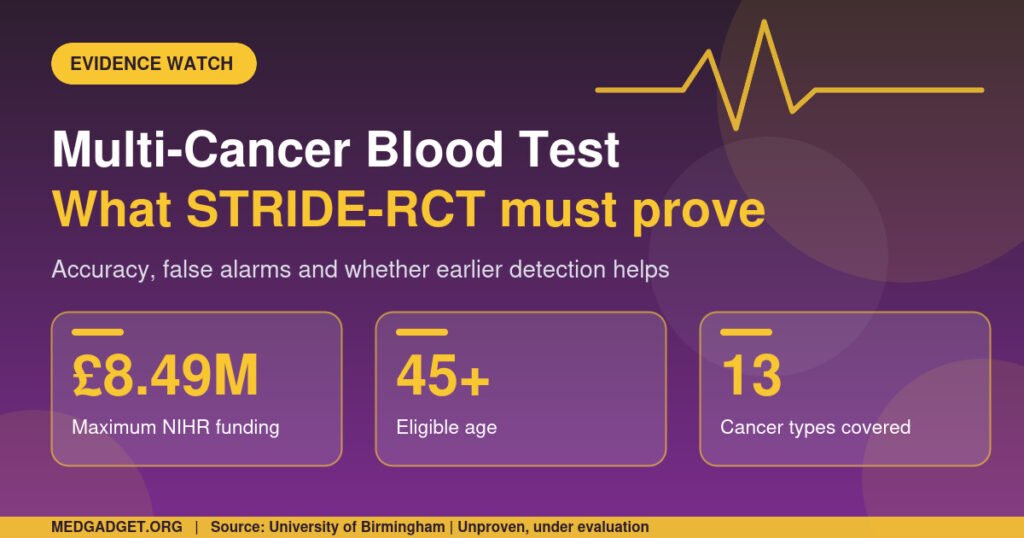

A multi-cancer blood test is only as useful as the evidence behind it, and on 4 November 2026 the University of Birmingham announced the trial meant to supply that evidence in routine care. STRIDE-RCT, a cluster platform trial across at least 200 GP practices in England, plans to enrol more than 20,000 patients aged 45 and over who present with abdominal symptoms. This article sets out what the trial can and cannot establish, and which numbers will matter when results arrive.
Key takeaways on the multi-cancer blood test trial
- STRIDE-RCT is funded with up to £8.49 million from the Office for Life Sciences through NIHR.
- It covers thirteen cancers, including bowel, pancreatic, ovarian, kidney, bladder and prostate cancer.
- The tests use technologies including artificial intelligence and blood protein measurement, but the specific test and developer are not named.
- The trial will assess performance alongside GP judgement before any decision on nationwide use.
- No performance data have been reported, so effectiveness is unproven.
What the trial design can show
A cluster platform trial assigns whole practices, not individual patients, to different approaches, and a platform design can add or drop tests as evidence accumulates. Cluster designs suit questions about how a test changes care, because the unit being studied is the practice’s decision-making. The announcement does not describe the arms, the randomisation or the primary outcome, so the following list sets out what such a study would normally need to answer. These are our framing, not trial specifications.
- Sensitivity: of patients who do have cancer, what share does the test flag?
- Specificity: of patients without cancer, what share does the test correctly clear?
- Positive predictive value: of those flagged, how many truly have cancer?
- Origin accuracy: when the test names a likely organ, how often is it right?
- Stage at diagnosis: are cancers found earlier when the test is used?
- Downstream effects: extra investigations, anxiety and cost.
Why the symptomatic setting matters
Studies of multi-cancer tests in people without symptoms and in people with symptoms answer different questions. Here, patients already have abdominal symptoms, which raises the chance that a cancer is present compared with the general population. That tends to make positive predictive value higher than in a screening setting, but it also means the results cannot be applied to screening healthy adults. The announcement is clear that the test is being assessed in people who visit a GP with symptoms.
Some of the cancers covered are among those most often found late. The announcement cites about 71,000 diagnoses and almost 35,000 deaths a year in England from pancreatic, stomach, liver, ovarian and bowel cancers, which frames the need but does not show that the test addresses it.
What investigators have said
Professor Aneel Bhangu, co-chief investigator, said the tests might help GPs but that the NHS needs to know for certain before using them across the service. Dr Anisha Patel, an NHS GP and bowel cancer survivor, said the trial offers hope that blood tests could improve early diagnosis. These are statements of aim and expectation, not findings.
Timeline
- 4 November 2026: trial announced as being launched.
- Recruitment dates and end date: not stated.
- Results: not expected to be available for some time; the announcement gives no date.
Limits to keep in mind
- Earlier detection does not automatically mean better survival; lead-time and overdiagnosis bias can make early detection look beneficial when it is not.
- A blood test that flags many conditions can generate false alarms that lead to unnecessary scans or procedures.
- Performance in a trial may differ from performance in routine practice.
- Results from one test cannot be assumed to apply to other multi-cancer tests.
Market context: cancer diagnostics
Acumen Research And Consulting has no report on multi-cancer blood tests, so its Cancer Diagnostics Market report is an adjacent source. It gives USD 142.3 billion for the global market, USD 276.2 billion by 2032 and a compound annual growth rate of 7.8% for 2024 to 2032, with North America at 41%.
The page states 2022 as the base year in one place and 2023 in another, and its growth rate does not match its endpoints, which imply roughly 6.9% to 7.6% annually by our arithmetic. We treat the figures as a rough indicator of the category, not as a measure of demand for multi-cancer tests.
Our analysis
In our assessment, the most important thing about STRIDE-RCT is that it tests the tests in the setting where they would be used, with GPs making decisions. That is a higher bar than a case-control study and a more informative one. The caveat is that a trial of this size can reveal how well a test performs overall but may be underpowered to show benefits for individual rare cancers, such as small bowel or gallbladder cancer.
What is not disclosed
- The test name, developer and methodology.
- The primary and secondary outcomes.
- Sample-size justification and subgroup plans.
- The start date and reporting timeline.
Risks and caveats
- The tests are being evaluated and are not proven.
- Trial results may not generalise beyond symptomatic adults aged 45 and over.
- Market statistics are adjacent and inconsistent.
- Not medical advice.
What to watch next
- Publication of the protocol and outcomes.
- Identification of the test and independent validation data.
- Recruitment progress.
- Any interim analyses.
General background
The announcement is at the University of Birmingham and funding information at NIHR. Related reading: our report on UK GP website outages and the Life Science section.
Questions readers are asking about the multi-cancer blood test
Is there proof the test works?
Not yet. The trial exists to find out.
Would this be used for screening healthy people?
The trial involves people with abdominal symptoms, not screening of healthy adults.
Why include so many cancers?
Because the aim is to see whether one sample can point to several cancers that share vague early symptoms.
FAQ
What does cluster platform trial mean?
Practices, not individuals, are allocated, and the design can adapt as evidence builds.
How big is the study?
More than 20,000 patients at 200 or more practices.
Who runs it?
The University of Birmingham.
How we reported this: details come from the University of Birmingham announcement of 4 November 2026; market figures are attributed to Acumen Research And Consulting. Last updated 4 November 2026. This is news reporting and not medical advice.