
The WATCHMAN FLX Pro clinical trial known as SIMPLAAFY asks a practical question for patients with a left atrial appendage closure implant: can they be protected with less intensive drug treatment afterwards? Reported on 2 November 2026 at TCT and in JAMA, the randomised study of 1,857 patients at 86 US sites found that aspirin alone and a short course of reduced-dose anticoagulant each met a noninferiority test against dual antiplatelet therapy at six months. This article appraises what was and was not reported.
Key takeaways from the WATCHMAN FLX Pro clinical trial
- Randomised, 1,857 patients with non-valvular atrial fibrillation, 86 US sites, WATCHMAN FLX Pro with HEMOCOAT.
- Three arms: aspirin alone; reduced-dose NOAC for three months then aspirin; aspirin plus clopidogrel for six months then aspirin (comparator).
- Noninferiority at six months was met by both lighter regimens; both showed less bleeding, rates not given in the release.
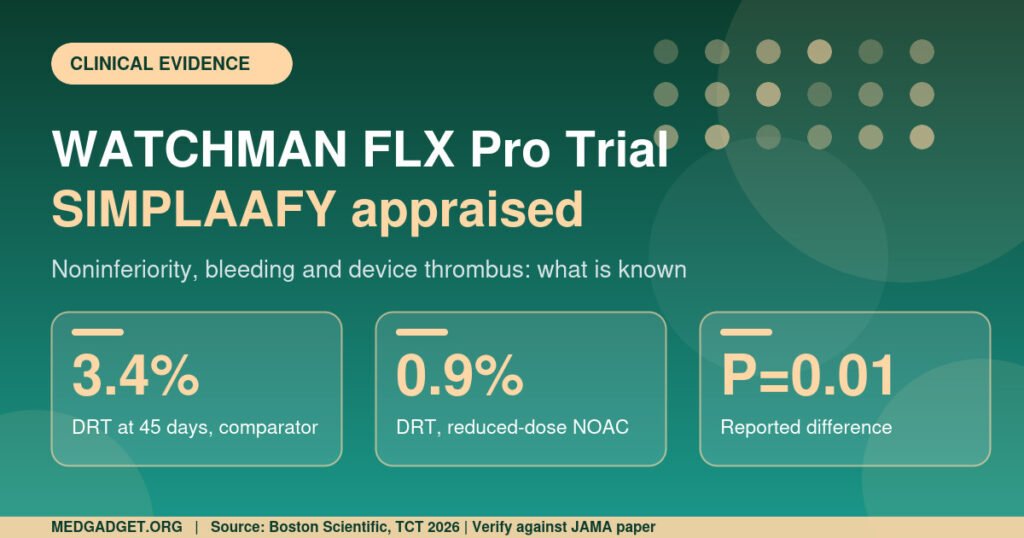
- Device-related thrombus at 45 days: 0.9% (reduced-dose NOAC) versus 3.4% (comparator), P=0.01.
- Ischaemic stroke 0.7%, described as equivalent to the comparator; the arm is not specified.
- The lighter regimens are investigational.
The clinical rationale
Left atrial appendage closure is intended for patients with non-valvular atrial fibrillation in whom the appendage is the main source of stroke-causing clots and for whom long-term anticoagulation is a concern. The device is a permanent implant, and tissue must grow over it before the clotting risk on its surface subsides. Standard post-implant regimens therefore combine antithrombotic drugs for weeks to months. Each added drug carries a bleeding cost, so the evidence question is whether a lighter regimen preserves protection. For general information on atrial fibrillation, see the American Heart Association.
Appraising the design
- Randomisation: assigning treatment at random reduces confounding, which is a strength compared with registry data.
- Active comparator: dual antiplatelet therapy is a recognised reference regimen, so the comparison is clinically meaningful.
- Noninferiority: the conclusion depends on a margin that the release does not state. A wide margin makes the test easier to pass.
- Open-label question: whether patients and clinicians knew the regimen is not described, which could influence reporting of bleeding.
- Follow-up: the six-month result is reported, with 12-month data to come.
Device-related thrombus
| Measure (45 days) | Reduced-dose NOAC | Comparator (DAPT) |
|---|---|---|
| Device-related thrombus | 0.9% | 3.4% |
| P value | 0.01 | Reference |
Device-related thrombus is a surrogate marker, found on imaging, and its link to later stroke is a matter of ongoing study. A lower rate is encouraging but is not by itself proof of fewer strokes. The release gives no thrombus figure for the aspirin-alone arm in the material we reviewed, so no comparison can be made for that regimen.
How a clinician might read the paper
These are our suggestions for what a careful reader would check, not statements from the investigators. First, the primary endpoint: which events were combined, and over what window? Second, the noninferiority margin and whether the confidence interval sits comfortably inside it. Third, the bleeding definitions, and whether the reduction is driven by minor or major events. Fourth, whether the thrombus findings were assessed by a blinded imaging core laboratory. Fifth, how many patients were switched between regimens or discontinued treatment, since a high crossover rate can blur differences between arms.
A sixth consideration is generalisability. Patients enrolled in a randomised trial at experienced centres may differ from those treated elsewhere, and the study tested one device. The results should not be assumed to apply to other closure devices or to patients outside the enrolled population.
Patient-level considerations
The decision about post-implant medication is individual. Factors such as previous bleeding, kidney function, other drugs and the anatomy of the implant all matter, and none can be judged from a headline result. Patients should not change any medication on the basis of a news report; any adjustment belongs in a discussion with their cardiologist.
Timeline
- 2023: WATCHMAN FLX Pro approved by the FDA.
- 2026: the Elite AF trial of the next-generation device begins.
- 2 November 2026: SIMPLAAFY results presented and published.
- Next: 12-month outcomes.
Expert and company comment
Dr Saibal Kar, a trial co-chair, and Dr Brad Sutton, Boston Scientific’s chief medical officer for Atrial Fibrillation Solutions, are quoted in the company release. Because the release is a promotional document, an independent reading of the JAMA paper is necessary to confirm primary endpoint definitions, bleeding classifications and the numbers behind the safety claims.
Market context: electrophysiology devices
Acumen Research And Consulting has no report dedicated to left atrial appendage closure. Its Electrophysiology Devices Market report is an adjacent source: USD 6.3 billion in 2022 rising to USD 17.6 billion by 2032, a compound annual growth rate of 10.9% from 2023 to 2032, with North America above 38%, Asia-Pacific about 12% and atrial fibrillation above 32% of 2022 revenue.
The page was last updated in May 2023, phrases the 2032 value as an increase of USD 17.6 billion (our arithmetic implies roughly USD 11.3 billion) and lists one company twice. We treat the figures as indicative and as not specific to closure devices.
Our analysis
In our assessment, SIMPLAAFY is a well-targeted randomised trial whose headline results are consistent, in direction, across bleeding, thrombus and noninferiority. The missing information is substantial: margins, absolute bleeding rates, per-arm stroke data and thrombus data for aspirin alone. Until those are checked in the paper, we regard the results as promising but not practice-changing, and as relevant only to the specific device studied.
What is not disclosed
- Absolute bleeding rates by arm.
- The noninferiority margins.
- Stroke and thrombus figures by arm beyond those quoted.
- Blinding details.
- Any plan to seek an updated label.
Risks and caveats
- Investigational regimens, not approved labelling.
- Source is a company release; the paper should be read.
- Thrombus is a surrogate outcome.
- Not medical advice.
What to watch next
- 12-month results.
- Guideline reaction from cardiology societies.
- Thrombus and stroke data for each arm.
- Elite AF trial progress.
General background
More from the company is at Boston Scientific and the journal at JAMA. Related device coverage: FDA flags on Edwards Commander M lots and Abbott’s CardioMEMS upgrade. More in Medical Device.
Questions readers are asking about the WATCHMAN FLX Pro clinical trial
Did the trial change approved treatment?
No. The lighter regimens are investigational.
Was aspirin alone as good as dual therapy?
The release says it met six-month noninferiority, with less bleeding, but the margin and rates were not given.
Why look at thrombus on the device?
Because clots on the implant can raise stroke risk, so it is a key safety marker.
FAQ
How many patients took part?
1,857 at 86 US sites.
What device was studied?
WATCHMAN FLX Pro with HEMOCOAT.
When is the next data?
12-month follow-up is planned.
How we reported this: details come from Boston Scientific’s announcement of 2 November 2026; market figures are attributed to Acumen Research And Consulting. Last updated 4 November 2026. This is news reporting and not medical advice.