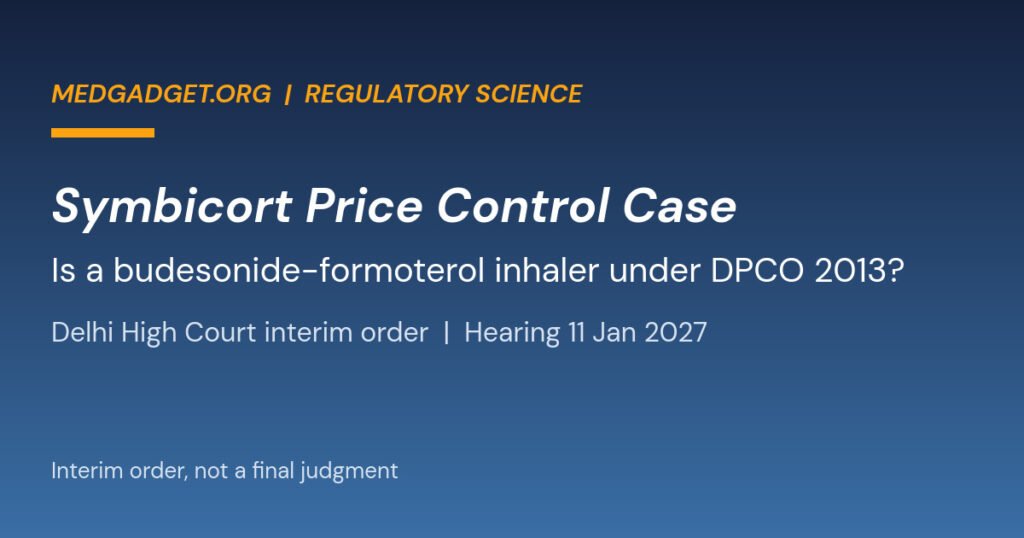

The Symbicort price control case is a question about how a medicine is classified before it is about how much it costs. The Delhi High Court has temporarily restrained India’s National Pharmaceutical Pricing Authority (NPPA) from coercive steps to recover more than ₹151 crore from AstraZeneca Pharma India over the Symbicort Turbuhaler 160/4.5 inhaler, after finding a prima facie case that the product may fall outside the price-controlled category.
Key takeaways from the Symbicort price control case
- NPPA alleges the Symbicort Turbuhaler 160/4.5 inhaler was sold above the permitted price from May 2016 to November 2025 under the Drugs (Prices Control) Order, 2013 (DPCO 2013).
- The demand is ₹1,51,19,66,035 (about ₹151.20 crore), which the company says includes interest up to 30 October 2026.
- The court, in an interim order dated 29 October 2026, said AstraZeneca made out a prima facie case that the inhaler may not be price-controlled.
- NPPA must take no coercive steps until the next hearing on 11 January 2027.
- AstraZeneca denies the allegations. No final finding has been made.
The science behind the product at the centre of the Symbicort price control case
Symbicort Turbuhaler is a dry-powder inhaler that delivers two active ingredients: budesonide, an inhaled corticosteroid, and formoterol, a long-acting beta-agonist. The corticosteroid reduces airway inflammation; the bronchodilator relaxes airway smooth muscle and widens the airways. The combination is used for maintenance treatment in asthma, and the 160/4.5 figures denote micrograms of budesonide and formoterol per delivered dose.
Why does pharmacology matter to a pricing dispute? Because price-control schedules are written around named active ingredients, strengths and dosage forms. Whether a fixed-dose combination in a specific device is the same “formulation” as the one the schedule lists is partly a regulatory-science question about how the entry is defined. The disclosure we have does not say how the company frames that argument, so we do not speculate on it.
How DPCO 2013 decides which medicines have a ceiling price
DPCO 2013 links price control to the National List of Essential Medicines. Formulations listed in the schedule receive a ceiling price set by NPPA from market data; other medicines can be sold at market prices, subject to a cap on annual increases that NPPA monitors. The authority can demand that a company deposit any overcharged amount with interest. The official orders and notifications are published on the NPPA website.
That structure explains the court’s focus. An overcharge demand presumes the product was subject to a ceiling in the first place. If the inhaler is outside the scheduled category, the demand’s foundation is in question; if it is inside, the amounts and interest then become the issue. Our earlier explainer on India’s cap on trade margins for 137 cancer drugs shows how NPPA’s powers operate in a different category.
Timeline of the Symbicort price control case
- May 2016 to November 2025: period of alleged overcharging.
- 11 September 2025: NPPA show-cause notice.
- 29 July 2026: demand notice, later followed by a reminder.
- 29 October 2026: Delhi High Court interim order; received by the company on 30 October.
- 2 November 2026: stock-exchange disclosure by AstraZeneca Pharma India.
- 11 January 2027: next hearing.
What the court has and has not found
Press reports name Justice Amit Mahajan as the judge. The order directs NPPA to take no coercive steps and to respond. A prima facie view is a preliminary assessment made to decide interim relief; it is not a ruling on the merits. For that reason this order should be read as evidence that the classification question is arguable, not that AstraZeneca has been vindicated or that NPPA’s claim has failed.
Market context: asthma therapy and inhalers
The dispute sits in a large therapeutic area. According to Acumen Research And Consulting, the global asthma therapeutics market was valued at USD 21.6 billion in 2022 and is forecast to reach USD 30.6 billion by 2032, growing at 3.6% a year over 2023 to 2032. The report says long-term control medications accounted for about 76% of the market in 2022, anti-inflammatory drugs were the leading class at over USD 9.3 billion, and inhalation was the largest route of administration. Asia-Pacific is expected to grow fastest, at above 4% a year.
Two caveats. The page is dated 25 July 2023, so it predates this case by some time. And our own arithmetic puts USD 21.6 billion compounded at 3.6% for ten years at about USD 30.4 billion, a shade below the stated figure, probably rounding. These are global figures and do not describe Symbicort’s sales in India.
Our analysis
In our assessment, the most informative thing to watch is NPPA’s written reply. The interim order tells us the court sees a real question about scheduling; the reply will show how the regulator defends its classification and how it calculated the overcharge. Until then, evidence on both sides is thin in public. The case may also matter beyond one inhaler, because classification of combination and device-delivered products can recur across the essential-medicines framework.
What is not disclosed
- The principal-versus-interest split of the ₹151 crore demand.
- NPPA’s calculation of the permitted price and overcharge.
- The exact legal reasoning on why the product may be outside control.
- The full text of the order, which we have not independently reviewed.
Risks and caveats
- Interim orders can be modified after the regulator responds.
- Our description of DPCO 2013 is general background and not a legal opinion.
- Facts about notices and dates come from the company disclosure and press reports.
- Nothing here is a clinical or prescribing recommendation.
What to watch next
- NPPA’s response and any affidavit on classification.
- The 11 January 2027 hearing and any extension of interim relief.
- Further company disclosures to the exchanges.
General background
Court listings are available on the Delhi High Court website. More drug-regulation coverage is in our Pharmaceutical section.
Questions readers are asking about the Symbicort price control case
Does the order change patient access to Symbicort?
No. It addresses recovery of past amounts, not prescribing or supply.
Has the court said Symbicort is not price-controlled?
No. It said a prima facie case exists that it may not be. The question is open.
What happens on 11 January 2027?
The court hears the matter again, and the no-coercive-steps protection runs until then.
FAQ
What is budesonide-formoterol used for?
It is used for maintenance treatment of asthma; a doctor decides whether it is appropriate for a given patient.
How much is the NPPA demand?
About ₹151.20 crore including interest to 30 October 2026, per the company.
Does AstraZeneca accept NPPA’s claim?
No, it denies selling above the notified price.
How we reported this: details come from AstraZeneca Pharma India’s stock-exchange disclosure, press reports and regulator and court sources; market figures are attributed to Acumen Research And Consulting. Last updated 3 November 2026. This is news reporting and not legal, financial or medical advice.