
The LCA-0061 food allergy drug is an investigational medicine from Lycia Therapeutics that aims to remove immunoglobulin E, the antibody behind allergic reactions, rather than block it. It is in an early Phase 1 trial that includes people with food allergy, and it has come into view because Lycia has filed to list its shares in the United States. This science-focused report explains what IgE does, how Lycia’s degrader approach differs from blocking antibodies, what early data the company reports and why a drop in IgE is not yet proof that patients are protected. The drug is not approved for any use, and this is not medical advice.
LCA-0061 food allergy drug: key takeaways
- LCA-0061 is an IgE degrader built on Lycia’s LYTAC platform and is in Phase 1.
- Early data from healthy atopic participants showed a mean maximum IgE reduction of 96% after one 70 mg subcutaneous dose, as reported by the company.
- More data are expected in 2027, and a follow-on candidate, LCA-0062, is in IND-enabling work.
- Lowering IgE is a biomarker result and does not show protection against allergic reactions.
- The company has no approved products and has not completed a clinical trial.
What IgE does, and why the LCA-0061 food allergy drug targets it
General background: in IgE-mediated food allergy, the immune system makes IgE antibodies against a food protein. These antibodies sit on mast cells and basophils, and on re-exposure to the food they trigger the release of chemicals that cause hives, swelling, vomiting and, in severe cases, anaphylaxis. Management today centres on avoiding the food and having emergency treatment available. The NIAID overview of food allergy gives more detail on the condition. This paragraph is general explanation and not a statement about Lycia’s data.
How the LCA-0061 food allergy drug is meant to work
According to the company’s registration statement, Lycia is a clinical-stage company developing therapies that degrade disease-causing extracellular proteins using its LYTAC platform, which builds on work by Nobel laureate Carolyn Bertozzi. In general terms, a LYTAC-type molecule binds a target protein outside cells and a receptor on a cell surface, so the cell takes the pair inside and sends it to the lysosome for breakdown. LCA-0061 is described as a catalytic version, called a cataLYTAC, that targets IgE. The idea is to clear IgE from circulation and not merely to bind it.
What the Phase 1 trial of the LCA-0061 food allergy drug is testing
The filing describes a Phase 1 trial in participants with elevated IgE, including people with food allergy. Phase 1 studies are mainly designed to assess safety and how the drug behaves in the body, and they are not designed to prove that it prevents allergic reactions. Trial listings can be checked on ClinicalTrials.gov. The company says additional data from the programme are expected in 2027.
The 96% IgE reduction: what it shows and what it does not
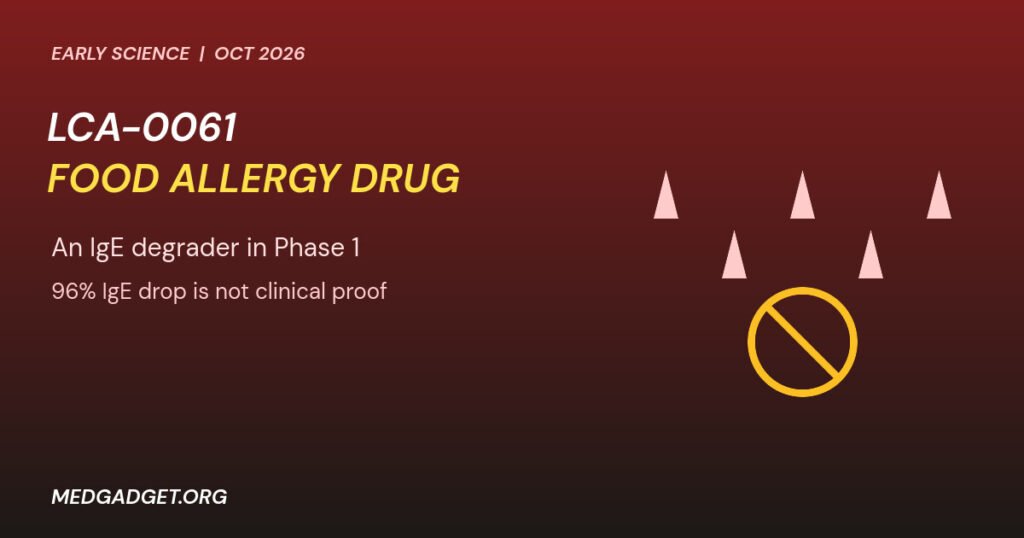
The company reports that, in healthy participants with allergic predisposition given a single 70 mg subcutaneous dose, the mean maximum reduction in IgE was 96%. That is a pharmacology result showing that the molecule can lower its target in people. It does not show how long the effect lasts, whether repeated dosing is safe, or whether lower IgE translates into fewer or milder reactions in people with food allergy. These are open questions that the filing does not answer, and we do not draw conclusions about them.
What a patient trial of the LCA-0061 food allergy drug would need to measure
General background: studies of food-allergy treatments typically test how much of the allergen a patient can tolerate under medical supervision before a reaction occurs, and compare that with placebo or with the patient’s own baseline. They also track the number and severity of reactions and any safety problems with repeated dosing. We have not seen a Lycia protocol of this kind, and the filing portion we read does not describe one, so this paragraph describes how such trials are commonly designed and not what Lycia has planned.
Why a degrader like the LCA-0061 food allergy drug is being tried
Antibody drugs that bind IgE already exist, so the scientific case for a degrader is that removing IgE might work differently from binding it. We have not seen independent evidence that comparing the two approaches favours either, and the company’s own comparative claims have not been tested head to head in the data we reviewed. This is a hypothesis under study, not an established advantage.
The rest of the LCA-0061 food allergy drug programme
- LCA-0062: a second IgE degrader, in IND-enabling work, with initial clinical data targeted for the second half of 2027 if cleared.
- LCA-0321: a degrader in Phase 1 for Graves’ disease, aimed at autoantibodies against the thyroid-stimulating hormone receptor, with initial data expected in 2027.
- Preclinical work in other autoimmune, inflammatory and allergic conditions.
What we could not assess
We did not review the full risk-factor discussion on competing allergy treatments, and we did not see safety data from the Phase 1 trial in the portion of the filing we read. We therefore make no claim about the drug’s tolerability. Readers should treat all efficacy statements in a securities filing as company descriptions of early work.
Risks and caveats on the LCA-0061 food allergy drug
- Early biomarker data often do not predict clinical benefit.
- The company lists unproven technology, competition and dependence on a few programmes among its risks.
- Safety in patients with food allergy is not yet reported in what we reviewed.
- This is news reporting, not medical advice.
In our assessment, the LCA-0061 food allergy drug is a credible but unproven attempt to deplete IgE, and the evidence that will matter is repeat-dose safety and reduced reactions in patients, neither of which has been reported. More in our life science coverage.
What to watch next on the LCA-0061 food allergy drug
- Additional Phase 1 data expected in 2027.
- Any trial in patients designed to measure allergic reactions.
- IND clearance and first data for LCA-0062.
Frequently asked questions
What is LCA-0061?
An investigational IgE degrader from Lycia Therapeutics in Phase 1 testing.
Does a 96% IgE reduction mean it works for food allergy?
No. It shows the drug lowers IgE in healthy participants, not that it prevents reactions.
Is it approved?
No. It is investigational.
How we reported this: we relied on the company’s registration statement and public health pages. General explanations are labelled. Last updated: 20 October 2026. This article is news reporting and not medical advice.