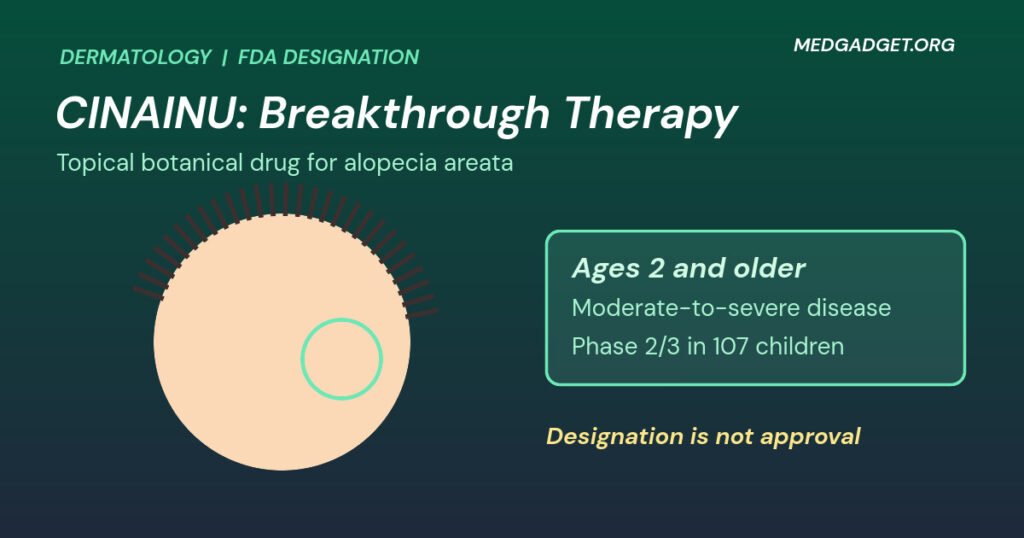

The CINAINU FDA Breakthrough Therapy designation gives a plant-derived skin treatment for alopecia areata a faster route through US regulatory review, but it does not mean the drug works well enough to be approved. On 13 October 2026, Legacy Healthcare announced that the US Food and Drug Administration had granted the status to CINAINU (also known as LH-8), an investigational topical solution for moderate-to-severe alopecia areata in adults, adolescents and children aged two years and older.
The company calls the decision a major milestone. This article explains what the designation means, what the company says supports it, and what is still missing from the public record.
Key takeaways
- The FDA granted Breakthrough Therapy designation to CINAINU for moderate-to-severe alopecia areata from age two upward.
- Legacy Healthcare, a Swiss company, says the decision was supported by a Phase 2/3 trial called RAAINBOW in 107 children and adolescents.
- The announcement gave no efficacy figures, so the size of the benefit is not public.
- The drug is not approved anywhere; a global Phase 3 programme is being prepared without a stated timeline.
What the CINAINU FDA Breakthrough Therapy designation means
The FDA grants Breakthrough Therapy designation to speed the development and review of medicines for serious conditions when early evidence suggests a substantial improvement over existing options. Benefits include closer contact with the agency and, in some cases, a faster review. It is a regulatory status. It does not signal that the FDA has reviewed the full data, and it does not guarantee approval.
Many drugs with the status still fail later or take years to reach patients. For readers, the useful question is what evidence the company presented, and on that the release is thin.
Alopecia areata treatment options and the CINAINU FDA Breakthrough Therapy
Alopecia areata is an autoimmune condition in which the immune system attacks hair follicles, causing patchy or complete hair loss. The National Institute of Arthritis and Musculoskeletal and Skin Diseases describes it as a common cause of hair loss that can affect people of any age. Hair may regrow without treatment, but the course is unpredictable.
Legacy says oral JAK inhibitors are the only approved treatments, and that they are limited to severe disease in adults and adolescents. The company also points out that these drugs carry boxed warnings for infections, cancer, cardiovascular events and blood clots, and that hair loss tends to return when they are stopped. It argues that patients with moderate disease and young children have no approved option. Those are the company’s statements of the unmet need.
What the CINAINU FDA Breakthrough Therapy decision rests on
According to the company, the designation was supported by RAAINBOW, a randomised, double-blind, placebo-controlled Phase 2/3 trial in 107 children and adolescents aged 2 to 17. Legacy says the trial showed meaningful hair regrowth, a favourable tolerability profile and benefit that lasted after treatment ended. The release does not report endpoints, regrowth percentages, comparison with placebo or safety counts. A registry entry for an earlier paediatric study of LH-8 is on ClinicalTrials.gov.
The designation covers adults as well, yet the trial the company cites enrolled only children and adolescents. The release does not explain what data support the adult claim, so readers should treat the adult indication as something the company has yet to show publicly.
What the CINAINU FDA Breakthrough Therapy drug actually is
Legacy describes CINAINU as a cutaneous solution and a multi-plant botanical prescription drug. It claims to be the first FDA-regulated multi-plant botanical drug to receive Breakthrough Therapy designation, which we could not verify independently. The release gives no detail on the ingredients, how it works or how often it is applied. Botanical drugs are regulated as drugs and must meet the same approval standards as other medicines.
The company says CINAINU is covered by six granted patents with protection extending to 2043. Legacy positions it as a possible first-line option for moderate-to-severe disease and, pending more study, as a follow-on after JAK inhibitors.
What happens next
Legacy says it is preparing a global pivotal Phase 3 programme in adults, adolescents and children. No start date, size or endpoints were given. Earlier in 2026 the company reported US clearance to move into Phase 3. Chief executive Saad Harti said the decision aims to offer patients meaningful regrowth and lasting benefit across ages and severity levels. For other recent regulatory milestones, see our report on the FDA clearing a Phase 2 trial of AK0406, or browse our pharmaceutical coverage.
Our assessment of the CINAINU FDA Breakthrough Therapy news
In our assessment, the CINAINU FDA Breakthrough Therapy designation is a meaningful regulatory step but a weak basis for judging the drug. A designation is a signal that the FDA saw early data worth speeding up, yet without published numbers we cannot tell whether the regrowth is modest or large, or whether it beats the placebo by a clinically useful margin. Children are an important group, since approved options are scarce, and a topical product with a good safety profile would be attractive. But the company has not yet shown adult data publicly, and the Phase 3 trials will decide the matter.
What to watch next after the CINAINU FDA Breakthrough Therapy
- Publication or presentation of the RAAINBOW efficacy and safety data.
- The design and start date of the Phase 3 programme.
- Evidence in adults, which the release does not show.
- Whether other regulators follow the FDA’s lead.
Frequently asked questions about the CINAINU FDA Breakthrough Therapy
What is the CINAINU FDA Breakthrough Therapy designation?
It is an FDA status intended to speed development and review of a drug for a serious condition when early evidence suggests a substantial advantage over current treatment.
Does the CINAINU FDA Breakthrough Therapy mean approval?
No. It is investigational, and Phase 3 trials are still being prepared.
Who is CINAINU for?
The designation covers moderate-to-severe alopecia areata in adults, adolescents and children aged two and older.
What did the trial show?
The company says it showed meaningful regrowth and good tolerability in 107 children and adolescents, but gave no figures.
Is CINAINU a JAK inhibitor?
No. The company describes it as a topical multi-plant botanical drug.
How we reported this: we relied on Legacy Healthcare’s 13 October 2026 announcement, which is a company statement, and on public regulatory information. Last updated: 14 October 2026. This article is news reporting and not medical advice.