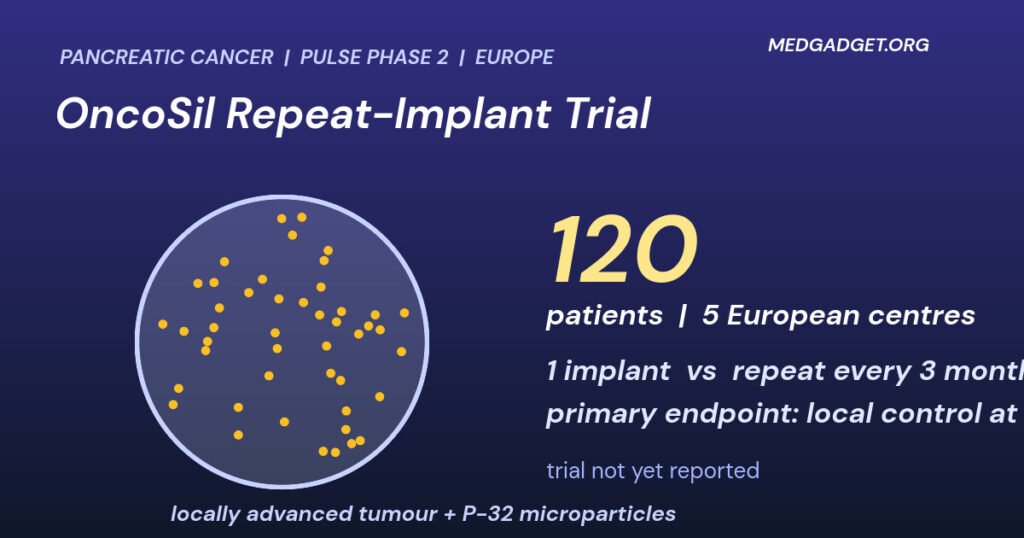

A new European study will test whether giving a radiation implant more than once helps patients with a hard-to-treat cancer. The OncoSil pancreatic cancer clinical trial, called PULSE, is a randomised Phase 2 study planned for 120 patients with locally advanced pancreatic cancer at five European centres. It will compare a single implant of the OncoSil Medical device with repeat implants every three months, and its main measure is how well the tumour is kept from growing locally after nine months.
PULSE sits inside PALACROS, a large EU-funded research programme on locally advanced pancreatic cancer. This is a new research plan, not a result. Nothing in it shows that repeated implants improve survival, and the trial has yet to report. Here is what is known about the design, the programme around it and the earlier data on the device, and what is still unclear.
OncoSil pancreatic cancer clinical trial: the design
- Name and phase: PULSE, a prospective, multicentre, randomised Phase 2 study.
- Patients: 120, across five European centres.
- Who is eligible: people with unresectable, non-progressing locally advanced pancreatic cancer after at least four months of induction chemotherapy.
- Comparison: patients are randomised 1:1 to a single OncoSil implantation or to repeat implantation every three months until the disease progresses.
- Primary endpoint: local progression-free survival at nine months.
- Secondary endpoints: overall progression-free survival, overall survival, safety, quality of life, pain, opioid use, conversion to surgery, biomarkers and a health economic assessment.
What OncoSil is
According to the company, the OncoSil device delivers phosphorus-32 microparticles directly into the tumour, alongside chemotherapy, so that radiation acts locally. The company says it carries a CE mark, covering the EU and UK, has been designated a breakthrough device in Europe and the US, and is approved for sale in more than 30 countries.
These are company statements. A breakthrough designation, explained by the FDA Breakthrough Devices Program, speeds interaction with regulators but does not mean a device works.
In plain terms, local radiation aims to damage the tumour while sparing surrounding tissue more than whole-body treatment would. Locally advanced pancreatic cancer is hard to treat, since the tumour has often grown around nearby blood vessels and cannot be removed safely at diagnosis. General information on the disease is available from the US National Cancer Institute.
The PALACROS programme behind the OncoSil pancreatic cancer clinical trial
PALACROS is funded under Horizon Europe through the EU Mission on Cancer. Its public record on the EU’s CORDIS database shows a total cost of about €10.56 million, of which the EU contributes about €10.0 million, with the programme running from 1 July 2026 to 30 June 2032. Amsterdam UMC in the Netherlands coordinates, and the record lists 21 other organisations in 12 countries, including OncoSil Medical Europe GmbH as an industry partner.
The programme’s aims are broad. Its stated impact target is to raise resection rates in locally advanced disease from under 5% to 10% in at least six European countries, extending median survival by about six months. It plans training in surgical centres, AI tools to identify patients who might be candidates for surgery, harmonised eligibility criteria, and several randomised trials.
A project update posted after its first in-person meeting in Amsterdam in mid-October 2026 said 46 people from 26 organisations took part, a figure that differs from the 22 organisations in the grant record, which we cannot reconcile. PULSE runs alongside the programme’s flagship trial as a separate investigation, according to coverage of the company’s announcement.
Who pays for the OncoSil pancreatic cancer clinical trial
OncoSil said in July 2026 that its European subsidiary had been selected for the programme and would supply devices in kind, with no other study costs falling on the company. It estimates this saves about A$9 million compared with a company-sponsored study of similar size. That is the company’s own estimate. A trial run in an academic consortium can add credibility through independent oversight, though the manufacturer still has a commercial interest in the outcome.
What earlier studies showed
PULSE builds on earlier work called TRIPP-FFX, PANCOSIL and PANCO. The best-documented summary we found is for PANCOSIL, an investigator-initiated, single-arm Phase 1-2 feasibility study from Amsterdam UMC, presented as preliminary results in September 2025. It enrolled 20 patients and used one CT-guided implant each. Reported results included no procedure-related deaths, technical success in 90%, two patients (10%) with serious grade 3 device effects within 90 days who recovered, and partial responses in three (15%).
The study also reported a median overall survival of 20.6 months from diagnosis against a historical figure of about 13 months. That comparison is not like-for-like: there was no control group, patients were selected after chemotherapy, and the follow-up was preliminary. It cannot be used to claim that the implant extends life, and the new randomised trial is designed precisely to answer such questions more reliably.
What the OncoSil pancreatic cancer clinical trial can and cannot tell us
- It can show whether repeat implantation delays local progression at nine months compared with a single one.
- It cannot, by itself, show an overall survival benefit, since survival is a secondary endpoint and Phase 2 trials are usually not large enough.
- It does not test OncoSil against no implant at all, because both arms receive the device.
- It has no reported start date, recruitment timeline or results date in the sources we reviewed.
Our assessment of the OncoSil pancreatic cancer clinical trial
In our assessment, the OncoSil pancreatic cancer clinical trial is a sensible next step for a device that has mostly been tested in small, uncontrolled studies. Comparing one implant with repeated implants asks a clear dosing question, and funding by an EU programme brings independent scrutiny. But it is early. Until recruitment is under way and results appear, patients and clinicians should treat the repeat-implant idea as a hypothesis.
For more pancreatic cancer research news, see our report on the Marsico Pancreatic Cancer Initiative, for another oncology regulatory milestone see Fast Track status for opamtistomig in biliary tract cancer, and browse our medical device coverage.
What to watch next in the OncoSil pancreatic cancer clinical trial
- The start of recruitment and the first patient treated.
- Publication of the full protocol and trial registration.
- Safety reporting for repeat implants.
- Progress of the wider PALACROS trials.
Frequently asked questions
What is the OncoSil pancreatic cancer clinical trial?
PULSE, a randomised Phase 2 study of 120 patients with locally advanced pancreatic cancer comparing a single OncoSil implant with repeat implants every three months.
What is the main goal of the OncoSil pancreatic cancer clinical trial?
To measure local progression-free survival at nine months.
Does the OncoSil pancreatic cancer clinical trial prove OncoSil extends survival?
No. It has not reported, and survival is a secondary endpoint.
What is PALACROS?
An EU-funded research programme on locally advanced pancreatic cancer, coordinated by Amsterdam UMC and running from July 2026 to June 2032.
Who is supplying devices for the OncoSil pancreatic cancer clinical trial?
OncoSil’s European subsidiary supplies them in kind, according to the company.
How we reported this: we relied on public records of the PALACROS grant, the company’s announcement of its participation, and published summaries of earlier OncoSil studies. We did not see the PULSE protocol. Figures labelled as ours are our own assessment. Last updated: 13 October 2026. This article is news reporting and not medical advice.