
The encaleret ADH1 Phase 3 data presented on 11 October 2026 suggest that an investigational drug can do more than correct blood calcium in a rare genetic condition. BridgeBio reported at the American Society for Bone and Mineral Research annual meeting in Boston that patients with autosomal dominant hypocalcaemia type 1 (ADH1) treated with encaleret in the CALIBRATE trial recovered their own parathyroid hormone (PTH) production, showed increased markers of bone turnover and more often reported symptom improvements than patients on standard care.
The patient-reported results are striking, but the release leaves out the group sizes, the statistical tests and the safety data. This report separates what was shown from what was not.
Key facts from the encaleret ADH1 Phase 3 data
- Comparison: 24 weeks of encaleret against standard of care, which is calcium supplements and/or active vitamin D.
- PTH recovery: PTH rose to at or above the lower limit of normal in 91% of encaleret participants and 0% on standard care.
- Bone turnover: markers of bone formation and resorption increased with encaleret relative to conventional therapy. No numbers were given.
- Symptoms: 100% of encaleret participants reported at least one improvement, against 46% on standard care.
- Regulatory status: an FDA application is under priority review with a target action date of 8 May 2027, and a European application has been submitted.
- Not reported: total trial size, safety and adverse events, and statistical testing for the symptom results.
What is ADH1, and what does encaleret do in the encaleret ADH1 Phase 3?
As general background, ADH1 is a rare inherited disorder caused by activating changes in the calcium-sensing receptor gene. The receptor behaves as if calcium were higher than it is, so the body makes too little PTH and the blood calcium falls while urinary calcium can run high. Standard treatment with calcium and active vitamin D raises blood calcium but can increase urinary calcium, and it does not restore PTH. Encaleret is an oral drug designed to block the overactive receptor. The company says the new data suggest it addresses the underlying biology, not only the blood calcium level. Those words are from Dr Imel, an investigator quoted in the release.
Results of the encaleret ADH1 Phase 3 trial: symptoms
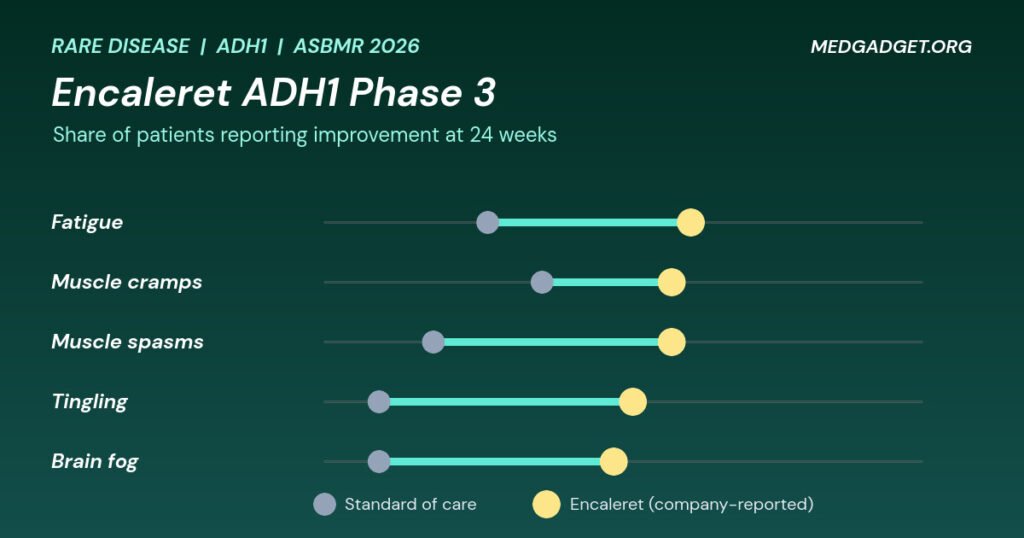
Patients were asked about specific symptoms over the 24 weeks. According to the company, the share reporting improvement on encaleret versus standard care was:
- Fatigue: 61.3% versus 27.3%.
- Muscle cramps: 58.1% versus 36.4%.
- Muscle spasms: 58.1% versus 18.2%.
- Tingling: 51.6% versus 9.1%.
- Brain fog: 48.4% versus 9.1%.
- Daily functioning, mood and emotions: 61.3% versus 27.3%.
- Physical activities: 45.2% versus 9.1%.
- Daily life: 35.5% versus 18.2%; work life: 35.5% versus 9.1%.
The release does not give denominators. The percentages are consistent with roughly 31 patients on encaleret and 11 on standard care, but that is our inference from the arithmetic, not a figure the company stated. If correct, the comparison group is small, and a single patient shifts its percentages by about nine points. The results are also patient-reported and exploratory, and the company itself cautions that such analyses may not predict clinical outcomes. They deserve attention, but they are not a substitute for the controlled primary results.
Bone turnover and PTH in the encaleret ADH1 Phase 3 study
PTH rose into the normal range in 91% of encaleret participants and in none of those on standard care. Bone formation and resorption markers rose with encaleret compared with conventional therapy. The company frames the increase as a sign of more physiological bone activity. We note that no numerical changes or statistical results were provided, and that the clinical meaning of higher turnover markers in this disease is for specialists to judge. Higher markers are not in themselves proof of better bone health.
Regulatory position after the encaleret ADH1 Phase 3
According to the company, the FDA accepted the encaleret application for ADH1 with priority review, with a target action date of 8 May 2027, and a marketing authorisation application has been submitted in Europe. Encaleret holds FDA Fast Track status and orphan drug designations in the US, EU and Japan. The FDA’s explanation of priority review describes what priority review means. It speeds the review clock but does not predict the outcome.
BridgeBio also announced that it has dosed the first participant in RECLAIM-HP, a global Phase 3 study in chronic hypoparathyroidism. The randomised, double-blind, placebo-controlled trial plans to enrol about 160 adults and adolescents at a 3:1 ratio to encaleret or placebo for 24 weeks, with a primary endpoint of the proportion with both blood and urine calcium in the target range at Week 24. Details are in the RECLAIM-HP registry entry (NCT07805356). A Hypoparathyroidism Association representative called the first dosing an important step towards asking whether the daily burden of managing the condition can be reduced.
Our assessment of the encaleret ADH1 Phase 3 results
In our assessment, the PTH and symptom signals are credible directionally because they match the drug’s mechanism, but they are small-sample, company-reported and incomplete. The safety silence matters most. A first drug for a rare disease will be judged on safety as much as efficacy, and the priority review will test the full dataset. The company also presented a family genetic testing poster with the patient association: of 27 participants, 44% were symptomatic when tested, and 77% of those had had symptoms for more than two years. That points to under-recognition, and again it is the company’s account.
What the encaleret ADH1 Phase 3 release leaves unanswered
- The size of each CALIBRATE arm.
- Safety, including adverse events and discontinuations.
- Statistical significance of the symptom and bone turnover findings.
- Whether the data have been peer reviewed or published.
- Long-term outcomes such as fractures, kidney calcium deposits and kidney function.
For another rare disease development, see our report on deucrictibant in Phase 3 for hereditary angioedema, or browse more pharmaceutical news.
Frequently asked questions
What did the encaleret ADH1 Phase 3 trial show?
Over 24 weeks, encaleret restored PTH to at least the lower limit of normal in 91% of participants, raised bone turnover markers and led to more patient-reported symptom improvements than standard care.
Is encaleret approved after the encaleret ADH1 Phase 3?
No. The FDA has accepted an application under priority review with a target date of 8 May 2027.
What is ADH1?
Autosomal dominant hypocalcaemia type 1, a rare inherited condition of low blood calcium and low PTH.
Was safety reported in the encaleret ADH1 Phase 3 release?
No. The release did not report adverse event data.
What is RECLAIM-HP, the follow-on to the encaleret ADH1 Phase 3?
A Phase 3 study of encaleret in chronic hypoparathyroidism, enrolling about 160 people.
How we reported this: we relied on the company’s announcement of 11 October 2026. Results are the company’s and have not been peer reviewed. Figures labelled as ours are our own inferences. Last updated: 13 October 2026. This article is news reporting and not medical advice.