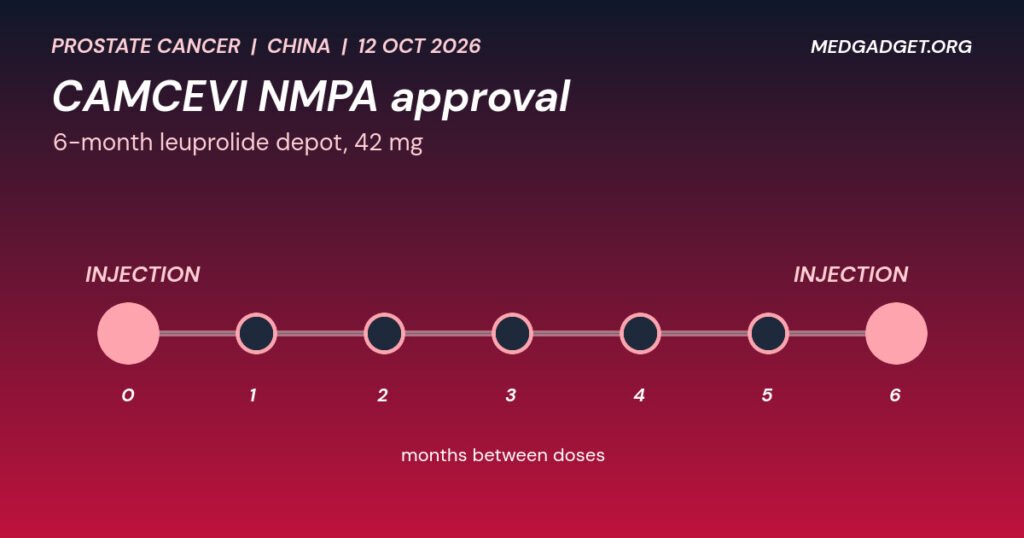

The CAMCEVI NMPA approval opens China to a six-month injection for advanced prostate cancer. On 12 October 2026, Foresee Pharmaceuticals (TPEx: 6576) said its licensing partner, Changchun GeneScience Pharmaceutical, known as GenSci, had been notified that the National Medical Products Administration approved the marketing application for CAMCEVI 42 mg. The product is a ready-to-use subcutaneous depot of leuprolide mesylate, a GnRH agonist, for adult patients with advanced prostate cancer.
The announcement is a regulatory milestone, not a data release. Below we set out what the company said, how the approval fits with its other markets, where its own account is inconsistent, and what remains unknown.
Key facts about the CAMCEVI NMPA approval
- What was approved: CAMCEVI 42 mg, a six-month leuprolide mesylate depot, for adults with advanced prostate cancer in China.
- Who sells it: GenSci holds exclusive China rights and will commercialise it.
- Label: Foresee says China’s label may differ from those in other countries.
- Not disclosed: the approval date, the registration number, efficacy and safety data behind the decision, price, reimbursement and launch timing.
- Other indications: GenSci holds China rights across current and pipeline uses, including central precocious puberty and premenopausal breast cancer.
What the CAMCEVI NMPA approval covers
Leuprolide is a GnRH agonist, a type of hormone therapy that lowers testosterone, which fuels many prostate cancers. A six-month depot means a patient needs two injections a year instead of more frequent dosing, a convenience that clinics and patients value for long-term treatment. The announcement describes CAMCEVI as ready to use, meaning it does not need to be mixed before injection. General information on prostate cancer and its treatment is available from the National Cancer Institute.
The release gives no clinical data supporting the China decision, so we cannot say how well it suppressed testosterone in the studies reviewed by regulators. Those details will appear in the Chinese prescribing information, which the company has not published.
Why a six-month interval matters after the CAMCEVI NMPA approval
As general background, not a claim from the company, hormone therapy for advanced prostate cancer is often continued for long periods, so the number of clinic visits adds up. Longer-acting depots reduce visits and may help patients stay on treatment, though the choice of formulation depends on the clinician, the patient and local availability. Different depot products release the drug at different rates, and their labels set out monitoring requirements, including blood testosterone checks. Because the China label may differ from labels elsewhere, as Foresee itself notes, readers should not assume the China prescribing information will match the US one. Details such as dosing instructions, warnings and monitoring will come from the approved Chinese label rather than from the announcement.
CAMCEVI NMPA approval: where else it is approved
According to the company, CAMCEVI was approved in the US in May 2021 and launched in April 2022. It lists approval in Canada in April 2026 and a UK authorisation from the Medicines and Healthcare products Regulatory Agency in August 2026, with Accord BioPharma and Accord Healthcare as partners. Taiwan and Israel are also listed as approved, without dates. A related product, CAMCEVI ETM, received FDA approval on 25 August 2025, with no details given.
One inconsistency is worth flagging. The company’s description of itself says CAMCEVI has been approved in the European Union since May 2022, while its milestone list cites a European Medicines Agency authorisation in May 2026. We cannot tell which is correct from the release, so we have not stated an EU date.
The GenSci partnership and the CAMCEVI NMPA approval pipeline
GenSci has exclusive rights in China to CAMCEVI across all current and pipeline indications. Beyond advanced prostate cancer, those include central precocious puberty (CPP) and premenopausal breast cancer. GenSci filed for premenopausal breast cancer in May 2026, and the NMPA accepted the filing for substantive review. The release describes that filing as a supplemental application in one place and a marketing authorisation application in another, so the exact procedure is unclear. A China Phase 3 trial of the six-month formulation in premenopausal breast cancer is complete, with no results given.
Separately, the company reports that FP-001, a six-month 42 mg formulation in CPP, met its Phase 3 primary endpoint in December 2025 (p = 0.0005), and that it plans a US new drug application in the second half of 2026. That is a US plan, not a China filing. The FDA’s new drug application process explains what such a submission involves. Foresee’s chairman and chief executive, Dr Ben Chien, said the company is pleased GenSci will launch CAMCEVI 42 mg in China, and that these efforts should contribute to growth of its global franchise. Those are company statements.
Our assessment of the CAMCEVI NMPA approval
In our assessment, the approval matters commercially more than clinically. The drug is already approved in several major markets, so the China decision extends an existing product rather than introducing a new mechanism. For Foresee, which relies on partners to sell its products, it adds the largest population base on its list. But the financial terms with GenSci, including milestones, royalties and sales expectations, were not disclosed, so the size of the benefit cannot be estimated. Launch timing and pricing will decide how quickly patients benefit, and prices and reimbursement in China are set through processes outside the NMPA approval itself.
What the CAMCEVI NMPA approval leaves unanswered
- The date of the NMPA decision and the registration details.
- Efficacy and safety data behind the China application.
- Launch date, price and reimbursement.
- The financial terms of the GenSci licence.
- Results of the China breast cancer Phase 3 trial.
For related prostate cancer coverage, see our report on targeted prostate cancer screening and the UK NHS, or browse more pharmaceutical news.
Frequently asked questions
What is the CAMCEVI NMPA approval?
China’s medicines regulator has approved CAMCEVI 42 mg, a six-month leuprolide depot, for adults with advanced prostate cancer, according to Foresee.
Who will sell CAMCEVI in China after the NMPA approval?
Changchun GeneScience Pharmaceutical, which holds exclusive China rights.
Where else is CAMCEVI approved besides the CAMCEVI NMPA approval?
The company lists the US, Canada, the UK, the EU, Taiwan and Israel, though its EU dates conflict.
When will CAMCEVI launch in China after the CAMCEVI NMPA approval?
No launch date was given.
Does the CAMCEVI NMPA approval include breast cancer?
No. A premenopausal breast cancer filing is under review, separately.
How we reported this: we relied on Foresee’s announcement of 12 October 2026. Approval history and pipeline details are the company’s. Last updated: 13 October 2026. This article is news reporting and not medical advice.