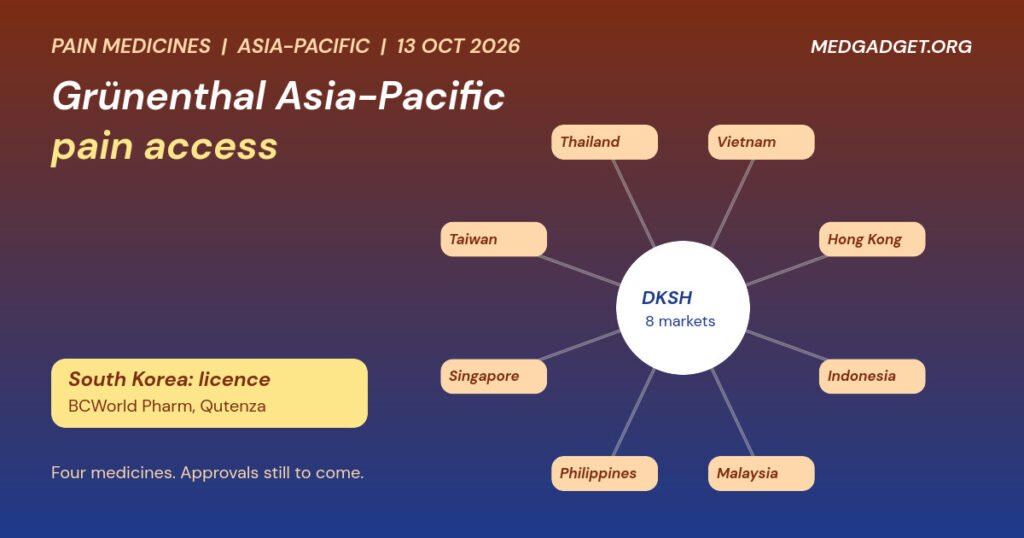

The Grünenthal Asia-Pacific pain access strategy now rests on two very different deals. In September 2026, Grünenthal agreed to let DKSH commercialise four established pain medicines in eight Asia-Pacific markets, and in March it licensed exclusive South Korean rights to its Qutenza patch to a local partner. Read together, they show how a European pain specialist intends to reach patients in a region it does not serve directly.
We covered the DKSH agreement when it was announced. This report looks at the wider picture: what each deal covers, how the two models differ, what has and has not been approved, and what the companies have left unsaid.
Key facts on Grünenthal Asia-Pacific pain access
- DKSH agreement (28 September 2026): Qutenza, Vimovo, Palexia and Zomig across Hong Kong, Indonesia, Malaysia, the Philippines, Singapore, Taiwan, Thailand and Vietnam.
- Roles: DKSH seeks local marketing authorisations and handles marketing, medical affairs, market access, sales and distribution. Grünenthal keeps manufacturing.
- Korea licence (5 March 2026): BCWorld Pharm receives exclusive rights to Qutenza in South Korea, for an upfront payment plus regulatory and sales milestones. Amounts were not disclosed.
- Approvals: none of the new market approvals is described as granted. Partners must still apply.
- Background: the DKSH relationship began in 2023 with Nebido, Zomig and Tramal in selected markets.
How the Grünenthal Asia-Pacific pain access model works
The eight-market agreement is a distribution and commercialisation partnership. DKSH, a market-expansion services group, takes on the local work of regulatory filings, marketing, medical activities, market access, sales and distribution. Grünenthal supplies the medicines from its global manufacturing network. The company says each market may receive up to four medicines, and that Zomig is being introduced in markets not covered by the 2023 arrangement.
The scale of the partners helps explain the choice. Grünenthal, based in Aachen, Germany, has affiliates in 28 countries, sells in about 100 and reported revenue of about €1.8 billion in 2025 with around 4,100 employees, according to the company. DKSH says it operates in 35 markets, with 2025 net sales of CHF 11.1 billion, of which its healthcare unit accounts for CHF 5.8 billion. In our assessment, a company of that reach is a natural partner for markets where setting up a full local sales force would be slow and costly. That is our reading, not a statement from either company.
The four medicines in the Grünenthal Asia-Pacific pain access plan
According to the companies, the portfolio spans several pain settings. Qutenza is a topical capsaicin 8% system, with a non-opioid, non-systemic mechanism, used for neuropathic pain. Its labelled uses differ between Europe, where it covers peripheral neuropathic pain in adults, and the US, where it covers postherpetic neuralgia and diabetic peripheral neuropathy of the feet. Vimovo combines esomeprazole and naproxen for adults with osteoarthritis, rheumatoid arthritis or ankylosing spondylitis who are at risk of NSAID-related ulcers. Zomig (zolmitriptan) treats acute migraine, and in some forms cluster headache. Palexia (tapentadol) is an opioid for severe pain, with formulations for chronic and acute use.
These indications come from the companies’ announcements and differ by country. Local labels in each Asia-Pacific market will be set by regulators, and nothing here is medical advice.
Korea: a different Grünenthal Asia-Pacific pain access route
In South Korea, Grünenthal chose a licence instead of a distribution partner. On 5 March 2026 it signed a definitive agreement giving BCWorld Pharm, a KOSDAQ-listed specialty pharmaceutical company, exclusive rights to Qutenza. BCWorld will seek marketing authorisation, and once approved will market and distribute the patch. Grünenthal receives an upfront payment and regulatory and sales-related milestones. The release also refers to an expanded collaboration on Nucynta but gives no details.
Under a licence, the partner takes more of the commercial risk and reward than a distributor does, and Grünenthal gets milestone income instead of controlling every sale. Marketing authorisation in Korea is handled by the Ministry of Food and Drug Safety, and the announcement does not say whether Qutenza has been filed or approved there. Grünenthal acquired the global rights to Qutenza in 2018, and says it has closed acquisitions with a total expected deal value above €2.3 billion since 2017.
Why Grünenthal Asia-Pacific pain access matters for pain treatment
The companies describe pain as a significant health challenge in Asia-Pacific, driven by ageing populations and a high burden of chronic disease. They say that hundreds of millions of people in the region may be living with chronic pain, an estimate based on population figures and global prevalence data rather than a regional survey. The International Association for the Study of Pain provides background on pain as a public health issue. Access to specialist treatments varies widely between countries, so the practical question is how quickly approved products reach clinics.
What the Grünenthal Asia-Pacific pain access plan leaves unanswered
- Timing: no approval or launch dates were given for any of the eight markets.
- Price and reimbursement: not discussed. These will shape real patient access.
- Deal values: the financial terms of both agreements were not disclosed.
- Existing availability: the announcements do not say which of the four medicines are already sold in these markets.
- Korea: approval status of Qutenza there was not stated.
For the earlier report on the DKSH agreement, see our article on the Grünenthal and DKSH partnership, or browse more pharmaceutical news.
Frequently asked questions
What is Grünenthal Asia-Pacific pain access?
It is the company’s plan to bring pain medicines to more patients in the region through partners, chiefly the DKSH agreement for eight markets and the BCWorld licence in South Korea.
Which markets does Grünenthal Asia-Pacific pain access cover under the DKSH deal?
Hong Kong, Indonesia, Malaysia, the Philippines, Singapore, Taiwan, Thailand and Vietnam.
Are the Grünenthal Asia-Pacific pain access medicines approved in those markets?
The announcement does not say approvals have been granted. DKSH will seek local marketing authorisations.
Who has the Qutenza rights in South Korea under Grünenthal Asia-Pacific pain access?
BCWorld Pharm, under an exclusive licence signed on 5 March 2026.
How much are the Grünenthal Asia-Pacific pain access deals worth?
The financial terms were not disclosed.
How we reported this: we relied on the companies’ announcements of 28 September 2026 and 5 March 2026. Company figures and strategy claims are the companies’. Last updated: 13 October 2026. This article is news reporting and not medical advice.