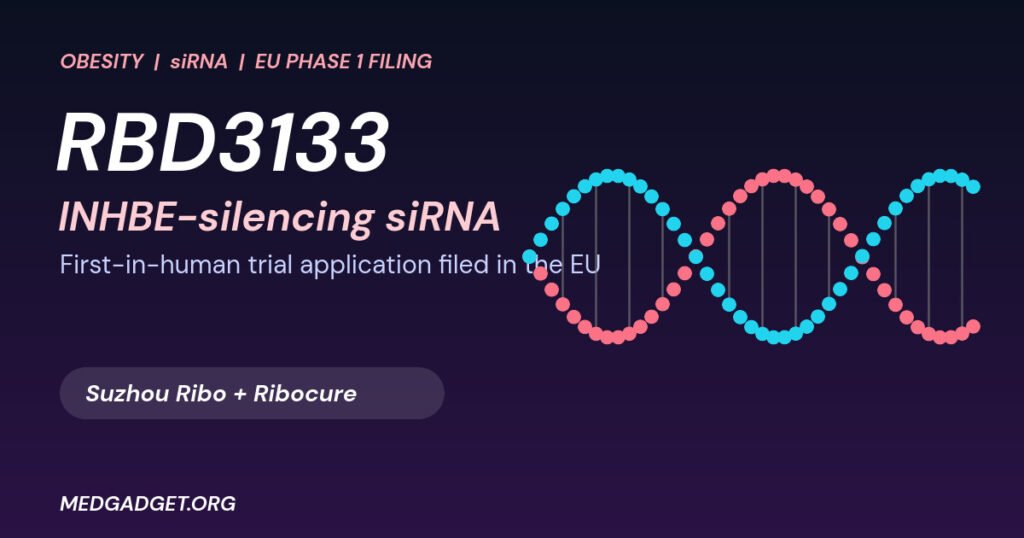

Ribo RBD3133 is heading towards its first human trial. Suzhou Ribo Life Science, together with its Swedish subsidiary Ribocure Pharmaceuticals, said on 8 October 2026 that it has submitted a European Clinical Trial Application for a Phase 1 study of RBD3133, a subcutaneous small interfering RNA (siRNA) that silences the INHBE gene, in people with overweight or obesity. It is the company’s first candidate in obesity.
The filing is a regulatory step, not a result. Approval status was not stated, and the company gave no preclinical data, dose levels or participant numbers. What it did give is the reasoning: human genetics suggests that switching INHBE down may be good for metabolic health. This article explains that reasoning, what the trial will look at, and what remains unknown.
Ribo RBD3133: the filing at a glance
- Drug: RBD3133, an siRNA designed to silence INHBE, the gene that encodes activin E.
- Indication: overweight and obesity.
- Trial: Phase 1, randomised and placebo-controlled, first-in-human.
- Route: subcutaneous injection.
- Measures: safety, tolerability, pharmacokinetics and pharmacodynamics.
- Filing: European Clinical Trial Application announced on 8 October 2026 by Ribo (HKEX: 06938) and Ribocure.
The idea: learning from people who lack the gene’s function
The case for INHBE rests on human genetics rather than animal models alone. According to Ribo, people who naturally carry loss-of-function variants in INHBE have healthier fat distribution, better metabolic characteristics and lower estimated risk of coronary heart disease and type 2 diabetes. In drug development, genetic findings like this are valued because they act as a natural experiment: if lifelong lower activity of a gene is associated with benefit, a drug that mimics it might be too.
INHBE encodes activin E, a protein made mainly in the liver. RNA interference drugs such as siRNA are well suited to liver targets, because they can be designed to find and degrade the messenger RNA of one gene and so reduce the protein made from it. In the company’s words, RBD3133 is designed to selectively silence INHBE.
Why an siRNA for obesity?
Most obesity drugs today are peptide hormones taken by regular injection that act on appetite and metabolism signals. An siRNA works differently: it reduces the production of a specific protein at its source. The appeal usually cited for the approach is that one dose can keep a target suppressed for a long time, which could allow infrequent dosing, although the company has not said how often RBD3133 would be given. That would be a meaningful practical advantage only if the drug is both safe and effective, which is what this trial is meant to start testing.
What the trial will examine
A first-in-human study of this kind is built to answer basic questions rather than to prove weight loss. The announced endpoints are:
- Safety and tolerability: what side effects occur and how participants cope with the injection.
- Pharmacokinetics: how the drug is absorbed, distributed and cleared.
- Pharmacodynamics: whether the drug lowers INHBE activity and moves relevant metabolic markers.
Ribo’s medical director, Anders Gabrielsen, described the submission as another clear step for its cardiometabolic portfolio and as showing that the company can turn human genetic evidence into RNAi medicines. That is a company statement of intent, not evidence.
How to read a first-in-human filing
Regulators in Europe review a clinical trial application for the quality of the manufacturing, the strength of the preclinical safety package and the design of the study, including how participants will be protected. A filing therefore tells us the company believes its data are good enough to dose people, but the data themselves usually stay private until later. Readers should treat the announcement as the start of a long path, with weight-loss efficacy not expected to be tested until later-phase trials.
What we do not know
- Any preclinical efficacy or safety data.
- Dose levels, schedule and duration of treatment.
- Number of participants, sites and countries.
- Start date, registry identifier and whether regulators have approved or raised objections.
- The chemistry and delivery technology behind the molecule.
Because of these gaps, we cannot say whether RBD3133 produces meaningful weight loss, how long its effect lasts, or how it compares with existing obesity drugs. Whether blocking the gene translates from genetics to a safe drug is the open scientific question.
The competitive landscape
Obesity drug development is crowded, dominated by hormone-based injections that mimic gut signals. INHBE is a newer idea. Reports on the filing note that Arrowhead Pharmaceuticals is testing an RNAi candidate against the same target, ARO-INHBE, in an early-stage study, with interim data presented at a scientific meeting in 2026 that were not yet peer-reviewed. We have not verified those data. The existence of a rival programme matters in two ways: it suggests other developers see the same genetic signal, and it means Ribo is not the first mover.
Why a European filing
Ribo is based in Suzhou, China, but the application goes through Ribocure in Sweden. In our assessment, that points to a strategy of building clinical capability in Europe rather than running the programme only from China. It also means the first human data will be generated under European regulatory oversight, which can matter for later partnering. The timing of the first dosing will depend on how quickly the review concludes.
For another regulatory-supply story, see our report on Axplora’s plan for European exatecan supply, or browse more pharmaceutical news.
What to watch next
- Approval of the clinical trial application and the first participant dosed.
- Publication of preclinical data supporting RBD3133.
- Early pharmacodynamic readouts showing target silencing.
- Progress of rival INHBE programmes.
Frequently asked questions
What is RBD3133?
A subcutaneous siRNA designed to silence the INHBE gene, being developed for overweight and obesity.
Has the trial been approved?
The company announced a submission. Approval status was not stated.
What is INHBE?
A gene that encodes activin E. People with natural loss-of-function variants reportedly have healthier fat distribution and lower estimated cardiometabolic risk.
Who is developing it?
Suzhou Ribo Life Science and its Swedish subsidiary, Ribocure Pharmaceuticals.
When will results be available?
No timeline has been given.
How we reported this: we relied on the company announcement of 8 October 2026. Mentions of a rival programme come from reports we could not verify. Last updated: 9 October 2026. This article is news reporting and not medical or investment advice.