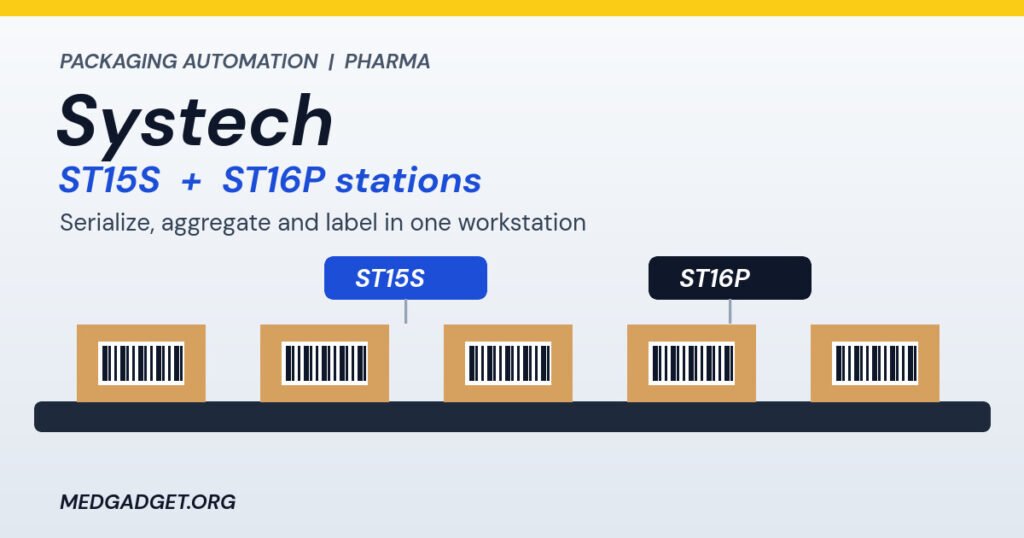

Systech ST15S and ST16P are two new packaging-line stations from Systech, the pharmaceutical serialization and traceability provider, designed to put several end-of-line jobs into a single workstation. The ST15S is a semi-automated serialization and aggregation station, and the ST16P is a multi-aggregation station with automated label printing and application. Details of both were published in trade coverage around CPHI Worldwide 2026, held in Milan from 6 to 8 October.
For drug makers and contract manufacturers, the pitch is practical: fewer separate machines, fewer hand-offs and less floor space, without redesigning the line. Here is what each station does, why it matters, and what we could not confirm.
The problem these stations target
Serialization gives each saleable pack a unique identifier. Aggregation then records which packs are inside which case, and which cases are on which pallet, so a shipment can be scanned and verified as a whole. Printing, inspection, aggregation and rework often happen at different stations, which means more people touching product, more movement between machines and more places for errors to creep in. Systech says its new stations pull those steps together.
ST15S: serialization, aggregation and rework in one place
- Combines semi-automated serialization with manual case aggregation, pallet aggregation and rework.
- Consolidates printing, inspection, aggregation and rework, which are often handled at separate stations.
- Runs on Systech’s UniSeries software.
- Sits on a mobile platform that can be repositioned as production needs change.
The ST15S looks aimed at lines that are not fully automated: it keeps a manual element for case aggregation while automating serialization, which can suit smaller batches, clinical supply and mixed product runs.
ST16P: multi-aggregation with automated label print and apply
- Combines semi-automated Pack-by-Layer aggregation with automated label printing and application.
- Aims to cut manual intervention and make labelling more consistent.
- Also runs on UniSeries and a mobile platform.
Pack-by-Layer is the company’s term for aggregating a pallet layer by layer. We have not seen a technical description beyond that, so we cannot say how many cases per minute either station handles.
What both stations have in common
- Designed to reduce operator touchpoints and product movement between stations.
- Meant to fit without major line redesign or facility expansion.
- Aimed at pharmaceutical manufacturers and contract development and manufacturing organisations (CDMOs).
- Positioned as improving productivity while supporting compliance requirements.
How a combined station changes the end of a packaging line
To see why a company would build these stations, it helps to walk through the typical end-of-line sequence that they are meant to shorten:
- Packs leave the filling and cartoning equipment and receive a unique serial number, usually printed as a 2D barcode.
- A vision system inspects the printed code to confirm it is readable and correct.
- Good packs are grouped into shipper cases, and the link between each pack and its case is recorded. This is aggregation.
- Cases receive their own labels, which are also verified.
- Cases are stacked on pallets and the pallet is linked to its cases.
- Any mislabelled or damaged unit is pulled out, corrected and re-recorded. This is rework.
On many lines, those steps are spread across several machines and operators. If one data record is missed or one label is applied wrongly, the whole case or pallet may have to be unpicked. Combining printing, inspection, aggregation and rework in a single station is intended to shorten that chain, but the saving depends on batch sizes, pack formats and staffing, none of which the launch material quantifies.
Compliance context
The launch coverage we reviewed refers to compliance in general terms and does not name a specific regulation. Systech’s website lists compliance with the US Drug Supply Chain Security Act (DSCSA) and the EU Falsified Medicines Directive among its solution areas. Readers should not assume that either station is certified for a particular regime; manufacturers should ask Systech which requirements each configuration has been validated against.
Where the stations fit in Systech’s range
Systech describes itself as a provider of regulatory compliance, supply chain transparency and brand protection, with offerings that include vision inspection, track and trace, serialization and authentication. The new stations extend the hardware side of that range, and both are built to work with its UniSeries serialization software. That software link matters: a station is only as useful as the data it passes to the plant and enterprise systems that hold the serial number records.
In our assessment: who should pay attention
Equipment makers have spent several years selling serialization hardware as a compliance cost. The current pitch is different: it frames the same equipment as a productivity tool, with fewer steps and less rework. That makes the claim worth testing. A packaging manager will want actual line data, such as rework rates, changeover times and the number of operators needed, before concluding that a combined station beats separate machines.
For related supply-chain technology coverage, see our report on Biomapas buying Pinnaxis to expand drug safety technology.
Questions to ask before buying
- What throughput does each station reach, and on which pack formats?
- Which regulatory regimes have the stations been validated for?
- How do they integrate with existing line controls and enterprise systems?
- What are the validation, training and maintenance requirements?
- Is the mobile platform suitable for a classified clean-room environment?
The vendor material we reviewed did not answer these, and we have not assumed answers.
Frequently asked questions
What is the Systech ST15S?
A semi-automated serialization and aggregation station that also handles manual case aggregation, pallet aggregation and rework in one workstation.
What does the ST16P do?
It combines semi-automated Pack-by-Layer aggregation with automated label printing and application.
Who are the stations for?
Pharmaceutical manufacturers and CDMOs.
Do they need a new line?
No. The company says they are meant to work without major line redesigns or facility expansion.
When were they launched?
The coverage we reviewed did not give a launch date. It appeared in reporting from CPHI Worldwide 2026.
How we reported this: we relied on the company’s product descriptions as published in trade coverage and on its website. Performance and compliance claims are the company’s own and have not been independently tested. Last updated: 9 October 2026. This article is news reporting and not purchasing or legal advice.