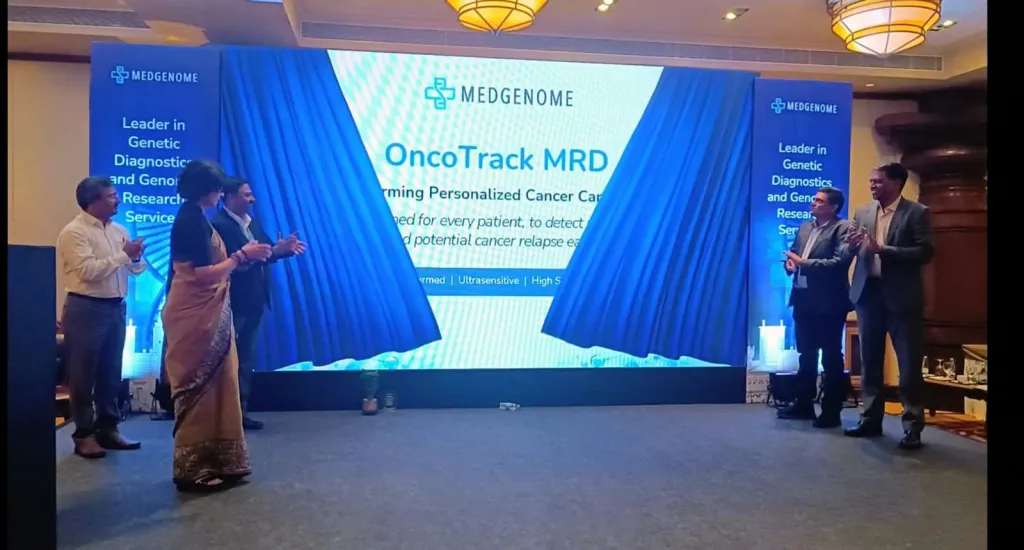

MedGenome has introduced OncoTrack MRD, a personalised molecular residual disease test designed to give oncologists a more detailed view of cancer after diagnosis and treatment. The new test uses tumour-informed next-generation sequencing (NGS) to identify extremely small amounts of cancer-related DNA circulating in the blood, creating a new option for monitoring patients for signs of residual disease and possible recurrence.
The Bengaluru-based launch brings molecular monitoring further into the clinical cancer care pathway in India, where physicians are increasingly looking for ways to detect changes in disease status before they become apparent through conventional follow-up methods. OncoTrack MRD was unveiled at an event featuring oncologists Dr Niti Raizada, Dr Vinayak Maka and Dr Rajeev Vijayakumar, alongside Ramprasad Vedam, PhD, CEO of MedGenome Labs.
The development also reflects the growing role of cancer diagnostics in supporting treatment decisions beyond the initial diagnosis. While imaging and other established assessments remain important in cancer management, molecular testing can provide another layer of information by examining tumour-derived signals in blood. MedGenome’s latest offering is aimed at patients who have already been diagnosed with cancer and require continued assessment following treatment.
Tumour-Informed Testing Brings Personalisation to MRD Monitoring
OncoTrack MRD is built around the individual patient’s tumour rather than a standard mutation panel applied across a broad population. Tumour tissue collected during the patient’s earlier diagnosis is used to create a personalised testing approach that identifies tumour-specific genetic signals.
The test then analyses circulating tumour DNA (ctDNA) from a blood sample. Because only a very small amount of tumour DNA may be present in the bloodstream, sensitivity is critical for MRD testing. MedGenome says its in-house technology is designed to detect and measure these low-level tumour-specific signals, allowing physicians to follow molecular changes that may indicate residual cancer.
This distinction is important in the post-treatment setting. A patient may show no obvious signs of disease through routine clinical assessment while microscopic cancer cells remain in the body. If these cells begin to increase, they can potentially contribute to a future relapse. By repeatedly assessing tumour DNA, molecular monitoring can give physicians an additional indicator of how a patient’s disease is behaving.
The test is therefore positioned as a longitudinal monitoring tool rather than a one-time diagnostic assessment. Depending on clinical requirements, patients can undergo blood testing multiple times during the year. Changes in ctDNA levels over successive tests can provide information on residual disease and treatment response, helping clinicians assess whether the disease appears to remain under control or whether further evaluation may be warranted.
For oncologists, the value of this approach lies partly in the ability to observe disease trends over time. Instead of relying only on individual scans or assessments taken at widely separated intervals, repeated molecular measurements can create a more continuous picture of the patient’s cancer status.
MedGenome Targets Wider Access to Molecular Cancer Monitoring
The launch also has a broader commercial and healthcare delivery dimension. As precision medicine becomes more established, cancer care is moving toward increasingly individualised approaches to diagnosis, treatment selection and disease surveillance. Testing platforms capable of generating patient-specific molecular information are becoming an important part of that shift.
MedGenome has developed OncoTrack MRD in-house, giving the company control over the testing methodology and its integration into its broader genomics and diagnostics capabilities. The offering extends the company’s role beyond conventional genetic testing toward applications that can be used throughout the cancer treatment journey.
Another factor is accessibility. MedGenome says OncoTrack MRD is available nationwide and supports home sample collection, reducing the need for patients to repeatedly travel to a testing centre. This could be particularly relevant for individuals requiring several rounds of monitoring over an extended period, as convenience can influence whether patients maintain recommended follow-up schedules.
The focus on repeat testing also creates potential value for clinicians managing patients with different treatment histories and recurrence risks. Rather than viewing cancer surveillance as a single milestone after treatment, physicians can use molecular results as one component of an ongoing assessment strategy.
At the Bengaluru event, the participating oncologists highlighted the importance of earlier identification of relapse and the role of molecular monitoring in personalised cancer care. Their involvement also reflects growing clinical interest in tools that can provide more information between major treatment or imaging milestones.
For the broader cancer diagnostics sector, the launch points to an expanding market for tests that support decision-making after the initial diagnosis. The ability to detect molecular evidence of disease at very low levels could have implications for how recurrence risk is assessed and how treatment response is followed in the future.
However, MRD testing is expected to complement rather than replace established clinical evaluation. Oncologists must interpret molecular findings alongside the patient’s clinical history, imaging results and other relevant evidence. The practical impact of testing will also depend on how physicians incorporate repeated molecular measurements into individual treatment plans.
With OncoTrack MRD, MedGenome is positioning personalised molecular surveillance as an accessible component of cancer care in India. The launch adds another layer to the country’s expanding precision oncology ecosystem and reflects a wider industry movement toward detecting disease changes earlier, monitoring patients more closely and using increasingly patient-specific information to guide cancer management.