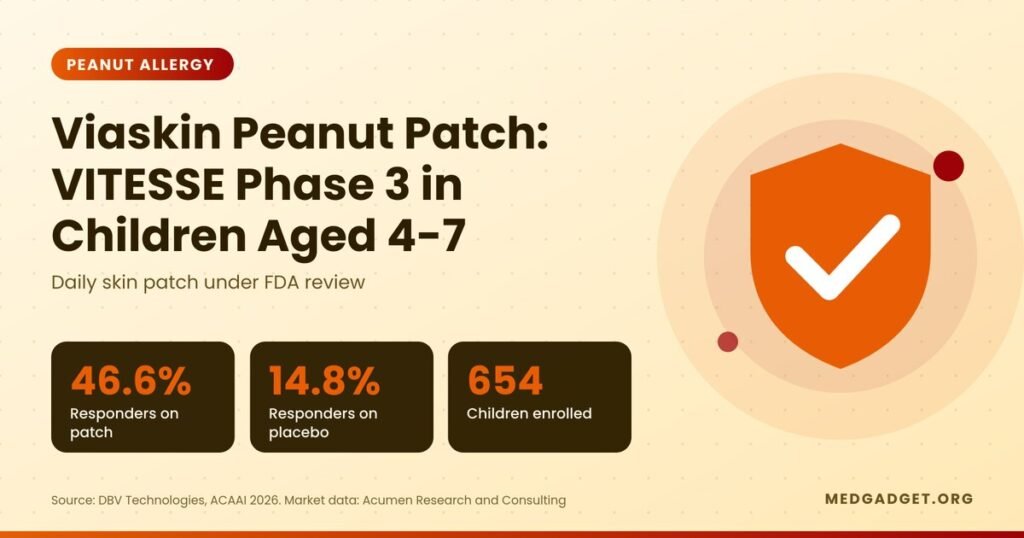

New data on the Viaskin Peanut Patch, presented by DBV Technologies at the American College of Allergy, Asthma and Immunology (ACAAI) 2026 meeting in Phoenix and announced on 12 November 2026, show that children aged 4 to 7 who wore the daily skin patch for a year reacted less often and less severely to peanut than children on a placebo patch. The 654-child VITESSE Phase 3 trial had already met its primary goal (46.6% responders vs 14.8%), and the treatment is now under FDA review after DBV filed a Biologics License Application in late September.
Key takeaways on the Viaskin Peanut Patch
- VITESSE enrolled 654 peanut-allergic children aged 4 to 7, randomised 2:1 to the 250 microgram patch or placebo for 12 months.
- 46.6% of patch users were responders at month 12 vs 14.8% on placebo, a 31.8-point gap (p<0.001).
- At or below each child’s starting reaction dose, moderate or severe reactions fell to 14.0% with the patch vs 50.0% with placebo.
- Compliance was about 96% in both arms, and children kept swimming, bathing and playing sports with the patch on.
- The BLA for ages 4 to 7 is filed with a Priority Review request; no FDA decision date has been published. A toddler (1 to 3) filing is planned for 2027.
What the new ACAAI analyses add
The headline result came out in December 2025. What parents and allergists did not yet have was a clearer picture of what “responder” means in daily life, which is the question the three ACAAI presentations tried to answer. A responder in VITESSE is a child whose eliciting dose, the smallest amount of peanut protein that triggers a reaction during a supervised food challenge, rose by a pre-set margin after 12 months.
The new analyses look at severity rather than just thresholds. At the month-12 double-blind food challenge, the maximum symptom severity was significantly lower in the patch group (p=0.004). Only 8.4% of treated children had a severe reaction during the challenge, compared with 12.5% on placebo, and 12.5% of treated children had no or only mild symptoms, versus 1.5% on placebo.
The most practical number for families is the one tied to a child’s own baseline. When challenged at or below the dose that originally made them react, 52.7% of children on the patch had no symptoms at all, against 19.2% on placebo. Moderate or severe reactions at that level dropped to 14.0% from 50.0%, which by our calculation is a 72% relative reduction. That is the scenario that matters most for accidental exposure: a hidden trace of peanut in a snack or a shared surface.
VITESSE results at a glance
| Measure (month 12) | Viaskin Peanut Patch | Placebo |
|---|---|---|
| Responders (primary endpoint) | 46.6% | 14.8% |
| Severe reaction at food challenge | 8.4% | 12.5% |
| No or mild symptoms at food challenge | 12.5% | 1.5% |
| No symptoms at or below baseline reaction dose | 52.7% | 19.2% |
| Moderate/severe reaction at or below baseline dose | 14.0% | 50.0% |
| Treatment compliance | 96.1% | 96.5% |
By our calculation, the 31.8-point responder gap implies that roughly one extra child becomes a responder for every three treated, a useful rule of thumb rather than a figure DBV reported.
How a skin patch can retrain a peanut allergy
The patch uses epicutaneous immunotherapy (EPIT). It holds a dry film containing 250 micrograms of peanut protein, about one thousandth of a peanut, against intact skin, usually on the back or upper arm, and is replaced daily. Small amounts of allergen are taken up by immune cells in the outer skin layers, which are thought to steer the response toward tolerance rather than an IgE-driven attack.
The immune markers moved in that direction. Peanut-specific IgG4, an antibody associated with tolerance, rose by month 3 and stayed up through month 12, while peanut-specific IgE and Ara h 2-specific IgE were significantly lower than placebo at month 12 (p=0.001). Skin-prick wheal size also shrank relative to placebo.
The approach differs from the two US-approved options. Palforzia is daily oral immunotherapy, where children swallow gradually increasing doses of peanut powder, and Xolair (omalizumab) is an injected antibody that raises reaction thresholds across several foods. A non-oral, non-injected option has long been the gap DBV is trying to fill. For context on other experimental approaches, see our report on the LCA-0061 IgE-degrader food allergy drug.
Safety and the limits of the data
According to DBV’s December 2025 topline report, most side effects were mild-to-moderate skin reactions where the patch sat, and treatment-related anaphylaxis occurred in 0.5% of children. The ACAAI release did not add new safety tables, so full adverse event and discontinuation figures are still awaited in a peer-reviewed paper.
Three caveats matter. First, the patch is not a cure: more than half of treated children were not responders, and an EpiPen and strict avoidance remain necessary. Second, the trial lasted 12 months; whether benefits hold or grow in the open-label extension, which runs up to three years, is not yet published. Third, results apply to ages 4 to 7 only. DBV has said it expects to file for toddlers aged 1 to 3 in 2027, but statements on that pathway are company views rather than FDA commitments.
Where the FDA review stands
DBV submitted the BLA on 29 September 2026 and asked for Priority Review, building on an earlier Breakthrough Therapy Designation. The company has not announced FDA acceptance or a PDUFA goal date. On its 28 October earnings call, DBV said it had told the agency it would be ready for a pre-approval inspection by 1 February, and noted that its contract manufacturer Fareva received an FDA warning letter in April 2026 and is awaiting reinspection. Manufacturing has history here: the FDA issued a Complete Response Letter for an earlier version of the patch in 2020, citing patch adhesion and design questions that VITESSE’s modified patch was built to address.
DBV reported $165.7 million in cash at the end of September, which it says funds operations into the third quarter of 2027, and plans a 50 to 70 person US sales force focused on about 4,500 allergists.
Market context
According to Acumen Research and Consulting, the global peanut allergy treatment market was worth USD 437 million in 2022 and is projected to reach USD 1,273 million by 2032, growing at an 11.5% CAGR. Acumen estimates North America held more than 40% of the market in 2022 and that epinephrine products accounted for over 47% of revenue, a reminder that emergency rescue, not prevention, still dominates spending. Acumen also notes peanut allergy affects about 2% of people in Western countries.
Frequently asked questions
Is the Viaskin Peanut Patch FDA approved?
No. DBV filed a Biologics License Application for children aged 4 to 7 in September 2026. The FDA has not announced a decision date, and the patch is not authorised for sale in any country.
How does the peanut patch work?
It delivers a tiny daily dose of peanut protein through the skin to gradually desensitise the immune system, a method called epicutaneous immunotherapy. It is worn continuously and changed every day.
Does the peanut patch cure peanut allergy?
No. It aims to reduce the chance and severity of reactions to accidental exposure. Children still need to avoid peanut and carry epinephrine.
What age is the peanut patch for?
The current FDA filing covers ages 4 to 7. DBV is studying toddlers aged 1 to 3 and expects a separate filing in 2027.
Sources: DBV Technologies ACAAI 2026 release; DBV BLA submission release; DBV Q3 2026 earnings call. Market data: Acumen Research and Consulting. More in our Biotechnology section. This article is not medical or investment advice. Last updated 13 November 2026.