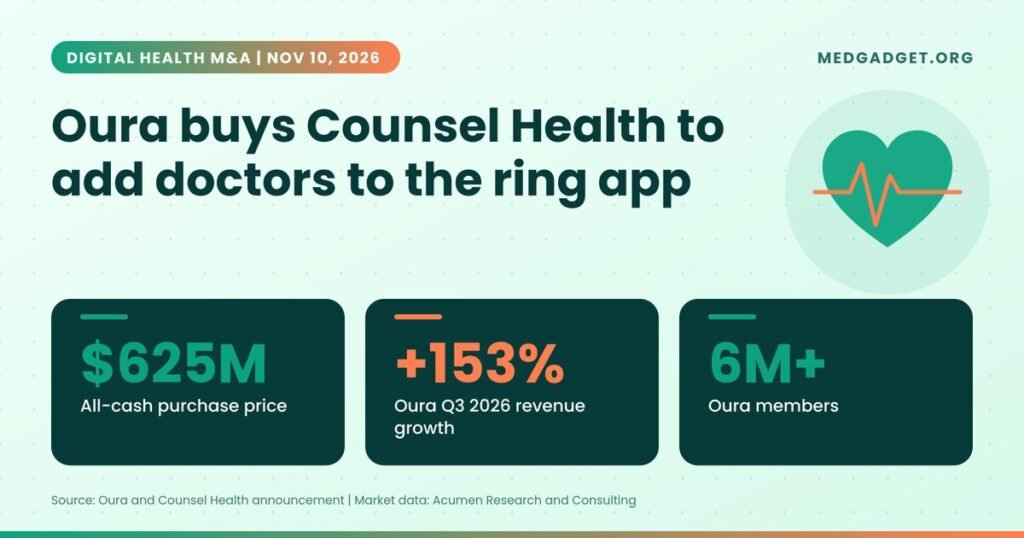

The Oura Counsel Health acquisition, announced on November 10, 2026, has the smart ring maker paying $625 million in cash for Counsel Health, an AI-native primary care company whose physicians already see Oura members through the Oura app. The deal turns Oura from a company that reports sleep, heart rate and temperature trends into one that can route a worried member to a board-certified doctor within minutes. Oura expects it to close before the end of 2026, subject to customary conditions.
Key takeaways on the Oura Counsel Health acquisition
- Price: $625 million in cash, subject to purchase price adjustments, per the companies’ joint announcement.
- Counsel pairs a medical AI assistant with in-house physicians, who make the clinical decisions using a tool Counsel calls the Clinician Cockpit.
- Oura members will be able to start from a ring insight or chat with Counsel AI, then escalate to a physician inside the Oura app.
- Oura reported preliminary, unaudited revenue of $533 million for the quarter ended September 30, 2026, up 153% year over year, and more than six million members.
- Counsel founder and CEO Muthu Alagappan, MD, is expected to join Oura as chief clinical AI officer, according to TechCrunch, citing Bloomberg.
From partner to owned clinic
This is not a cold acquisition. Counsel’s chat-plus-physician service was built into the Oura app in June 2026, so Oura has had several months of real usage data before committing $625 million. Counsel says its AI draws on connected medical records, prior conversations, clinical guidelines and wearable biometrics, and that a human doctor stays accountable for every medical decision.
Oura’s executive chairman, David Shuman, summed up the logic in one line: “Oura tells members what’s happening in their bodies, and Counsel helps them act on it.” In practice, that means a member who sees an unusual resting heart rate or temperature trend would no longer be left to search the web or book a separate telehealth visit. The conversation and the data stay in one place.
Counsel will keep its existing business with health plans, health systems, employers and consumer health companies, and says it wants to reach patients beyond Oura’s member base. That matters, because it means Oura is buying a care platform with outside revenue potential, not only a feature for its own app.
The deal in numbers
| Item | Figure | Source |
|---|---|---|
| Purchase price | $625 million, cash | Joint announcement |
| Expected close | Before end of 2026 | Joint announcement |
| Oura Q3 2026 revenue | $533 million (+153% YoY) | Oura, preliminary |
| Oura Q3 adjusted EBITDA | $87 million (16% margin) | Oura, preliminary |
| Oura fiscal 2026 revenue | About $1.75 billion (+92%) | Oura, preliminary |
| Oura members | More than 6 million | Oura |
| Counsel Series A (2025) | $25 million, led by a16z and GV | TechCrunch |
| Counsel staff joining | About 70 | TechCrunch, citing Bloomberg |
By our calculation, the price equals roughly 36% of Oura’s reported fiscal 2026 revenue, and about 5.7% of the $11 billion valuation TechCrunch reports Oura reached after its October 2025 funding round. For a company that has postponed a planned IPO indefinitely, according to TechCrunch, spending that much cash signals confidence in its own cash generation, helped by an adjusted EBITDA margin of 16% last quarter.
What changes for Oura members
According to the announcement and coverage in HIT Consultant, the combined service is planned across three tracks:
- Preventive care: spotting early signs of illness or metabolic drift from biometric trends.
- Acute care: triage, guidance, lab orders and electronic prescriptions.
- Specialty and chronic care: longer-term support in cardiometabolic health, reproductive and hormonal health, perimenopause and aging.
Neither company has published pricing, the states where physician visits will be available at launch, or whether insurance will cover the service. Members should expect those details closer to closing. Counsel reports a 4.6 out of 5 average satisfaction score and says more than 90% of members in its internal evaluations felt biometric context improved their visits; those are company figures, not independent study results.
The regulatory fine print
Oura’s own disclaimer is worth reading closely: it states that the Oura Ring is not a medical device and is not intended to diagnose, treat, cure, monitor or prevent disease. Counsel describes its AI content as informational and not a substitute for professional care. That split is deliberate. The ring produces wellness data; a licensed physician, not the algorithm, makes the clinical call.
The approach mirrors a wider debate about patient-facing AI, which we explored in our look at what evidence and safeguards should back Ro’s Robin AI health agent. The open questions are similar: how often the AI escalates correctly, how errors are audited, and how wearable data that was never validated for diagnosis is weighed in a medical decision. Neither Oura nor Counsel has released peer-reviewed outcome data on the combined model.
Market context
Oura is moving into a fast-growing slice of care delivery. Acumen Research and Consulting sized the global telehealth market at USD 84.1 billion in 2022 and projects it to reach USD 716.5 billion by 2032, a compound annual growth rate of 24.2%, with North America the largest region. Acumen’s report dates from late 2023, so the figures are best read as directional.
The strategic read is that wearables are converging with virtual care. Telehealth companies are adding AI agents and branded drugs, as seen in deals such as Lilly’s Zepbound arrangement with Hims & Hers, while device makers are reaching the other way into clinical services. Oura’s edge is a large, engaged base that already generates continuous data; its risk is taking on the cost, liability and licensing burden of running a medical practice. TechCrunch notes rivals such as RingConn and Ultrahuman are pressuring Oura on hardware, which helps explain the push into services.
What to watch next
- Closing of the deal, expected before year-end 2026.
- Pricing and whether physician access is bundled into Oura membership or sold separately.
- State-by-state availability and any insurer or employer coverage.
- Any published clinical or safety data on AI triage plus wearable data.
- Whether Oura revives its IPO plans with a services story attached.
FAQ
How much is Oura paying for Counsel Health?
$625 million in cash, subject to purchase price adjustments, according to the November 10, 2026 announcement.
What is Counsel Health?
An AI-native primary care company founded by physician Muthu Alagappan. Members chat with Counsel AI and can be escalated to a board-certified Counsel physician, who makes clinical decisions.
Can the Oura app now connect me to a doctor?
Counsel has been integrated into the Oura app since June 2026. The companies say the combined service will let members escalate a chat to a physician within minutes; pricing and availability have not been published.
Is the Oura Ring a medical device?
No. Oura states the ring is not a medical device and is not intended to diagnose or treat disease. Medical decisions in the Counsel service are made by licensed physicians.
Sources: Oura and Counsel Health joint announcement (November 10, 2026); TechCrunch; HIT Consultant. Market data: Acumen Research and Consulting. More in Healthcare IT. Not medical or investment advice. Last updated: November 12, 2026.