

Transcatheter tricuspid valve repair gained randomised evidence on 2 November 2026, when Edwards Lifesciences reported results from CLASP II TR at TCT. In 450 patients with severe tricuspid regurgitation despite medical therapy, adding the PASCAL system to medical therapy improved a hierarchical primary endpoint at six months, driven mainly by patient-reported health status, and reduced valve leakage at one year. All-cause mortality, however, was numerically higher with the device. This article weighs the evidence.
Key takeaways on transcatheter tricuspid valve repair from CLASP II TR
- 450 patients randomised 2:1: PASCAL plus optimal medical therapy (302) versus medical therapy alone (148).
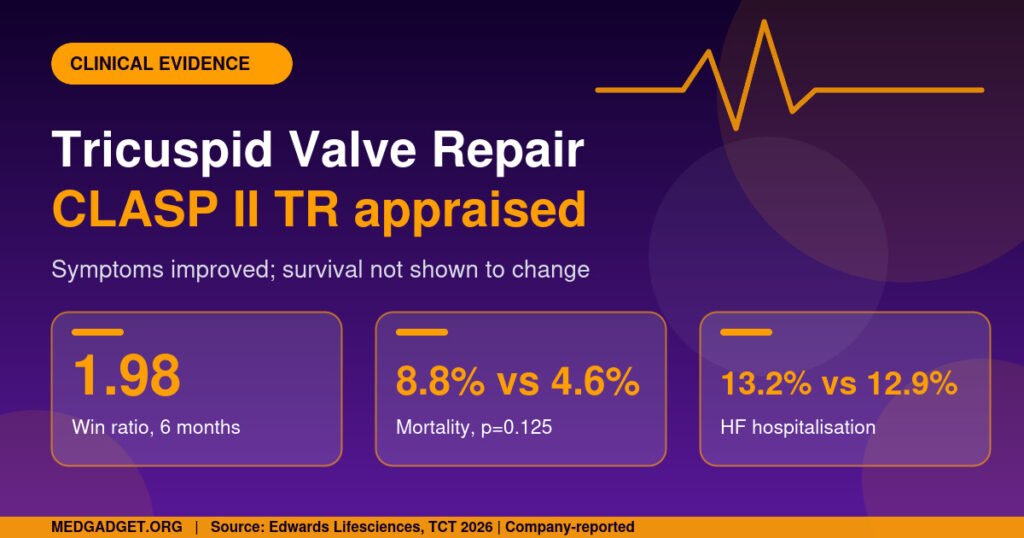
- Primary endpoint at six months: win ratio 1.98 (95% CI 1.47 to 2.67; p below 0.001), mainly driven by KCCQ-OS.
- TR reduced to moderate or less at one year in 80% versus 30%.
- Mortality 8.8% versus 4.6% (p=0.125); heart-failure hospitalisation 13.2% versus 12.9% (p=0.831).
- Tricuspid interventions 5.5% versus 15.8%.
- Edwards reports FDA approval in October 2026; we could not verify this independently.
Disease background
Tricuspid regurgitation is backward flow across the valve between the right heart chambers. When severe it is associated with symptoms of right heart failure and a poorer outlook, but the best treatment is unsettled. Surgery carries risk in older patients and those with other diseases, and medicines mainly relieve congestion. The patients in this trial had severe or greater regurgitation despite medical therapy, were in NYHA class II to IVa, and were at intermediate or high surgical risk. The American Heart Association has general patient information on valve disease.
The intervention
PASCAL is delivered by catheter through a vein and is designed to join parts of the valve leaflets, reducing the regurgitant gap while retaining native tissue. The material we reviewed did not specify procedural details, such as the average number of devices implanted or procedure times.
Why does this matter for evidence? A device that reduces leakage should, in principle, relieve congestion and improve symptoms, and the reported fall in regurgitation severity fits that mechanism. Whether it also changes survival depends on timing and patient selection: patients treated late, with advanced right heart or organ damage, may not benefit in the same way as those treated earlier. The announcement does not report results by disease stage.
Trial results in a table
| Outcome | PASCAL plus medical therapy | Medical therapy alone |
|---|---|---|
| Patients | 302 | 148 |
| TR moderate or less (1 year) | 80% | 30% |
| Tricuspid interventions | 5.5% | 15.8% |
| All-cause mortality | 8.8% | 4.6% |
| Heart-failure hospitalisation | 13.2% | 12.9% |
Reading the primary endpoint
A win ratio compares each patient in one group with each in the other, working down a ranked list of outcomes. A ratio of 1.98 means that, among comparable pairs where a winner could be identified, the PASCAL patient won roughly twice as often as the control patient. Because the primary endpoint was driven mainly by KCCQ-OS, a questionnaire of symptoms and quality of life, the result reflects how patients felt more than hard events. Edwards describes an 18-point improvement, which it calls clinically significant. Without the ranked hierarchy and the score distributions, we cannot determine how much each component contributed.
Patient-reported outcomes are valuable, because relief of symptoms is a legitimate goal of treatment, yet they are susceptible to expectation effects when patients know which treatment they received. The material we reviewed does not describe any blinding.
Safety and survival
The mortality figures, 8.8% versus 4.6%, were not statistically different, but the trial was not necessarily powered to detect a difference in survival, so absence of significance does not demonstrate equivalence. Heart-failure hospitalisation was similar, at 13.2% versus 12.9%. The adjudicated composite major adverse event rate was 6.9% at 30 days and 20.1% at one year, and single leaflet device attachment was 3.4% at 30 days and 4.8% at one year; these were not split by arm in the material we saw. These numbers merit scrutiny in the full paper.
Timeline
- 2020: CE Mark reported by Edwards (not independently verified).
- October 2026: Edwards reports FDA approval for tricuspid repair (not independently verified).
- 2 November 2026: CLASP II TR presented at TCT 2026.
Market context: transcatheter heart valves
Acumen Research And Consulting has no tricuspid-specific report, so its Transcatheter Heart Valve Replacement Systems Market report is adjacent: USD 5.1 billion in 2022 to USD 14.7 billion by 2032, a compound annual growth rate of 11.4% for 2023 to 2032, with North America about USD 1.9 billion, Asia-Pacific above 12% and transcatheter aortic valve replacement about USD 4.3 billion.
The page was last updated in February 2024, calls the tricuspid valve a left-side valve (it is on the right) and mentions coronary valves, and its stated growth rate compounds to about USD 15.0 billion by our calculation. We use it for category context only.
Our analysis
In our assessment, CLASP II TR gives the strongest randomised case yet reported by Edwards for symptom benefit with catheter-based tricuspid repair, and the reduction in leakage supports a plausible mechanism. It does not show a survival benefit or fewer hospitalisations, and the numerically higher mortality is a signal that must be examined. The proper conclusion is cautious support for symptom-driven treatment decisions in selected patients, with a need for longer follow-up.
What is not disclosed
- The win-ratio hierarchy and KCCQ values by arm.
- Safety events by treatment arm.
- Causes of death.
- Blinding.
- Details of the FDA approval.
Risks and caveats
- Numerically higher mortality with PASCAL.
- Primary endpoint driven by a patient-reported measure.
- Data from a company release and conference.
- Not medical advice.
What to watch next
- Full publication.
- Two- and three-year follow-up.
- Guideline recommendations.
- Comparisons with other tricuspid devices.
General background
More from the company: Edwards Lifesciences. Related coverage: FDA flags on Edwards Commander M lots. See the Medical Device category for more.
Questions readers are asking about transcatheter tricuspid valve repair
Is catheter repair better than medicines alone?
For health status and leakage, the trial says yes; for survival and hospitalisation, it does not show a difference.
Why is the mortality figure a concern?
It was higher with PASCAL, though not significantly, and the trial may not be powered to settle the question.
Was the approval new?
Edwards says it received FDA approval in October 2026; this has not been verified here.
FAQ
What is tricuspid regurgitation?
Backward leakage across the tricuspid valve.
How many patients were studied?
450 analysed.
What is KCCQ-OS?
The overall summary score of a heart-failure health status questionnaire.
How we reported this: details come from Edwards Lifesciences’ announcement of 2 November 2026 and a conference report; market figures are attributed to Acumen Research And Consulting. Last updated 4 November 2026. This is news reporting and not medical advice.