
TNF inhibitor biosimilars are at the centre of a US commercial agreement announced on 3 November 2026, in which Teva will take over US commercialisation of ETICOVO (etanercept-ykro) and infliximab-abda from Samsung Bioepis. Both are biosimilars of long-established biologic medicines, Enbrel and Remicade, and both were approved by the FDA years ago, in 2019 and 2017. This article looks at the science and the evidence framework behind such products, and at what the announcement does not tell us.
Key takeaways on TNF inhibitor biosimilars in this deal
- ETICOVO (etanercept-ykro) references Enbrel; infliximab-abda references Remicade.
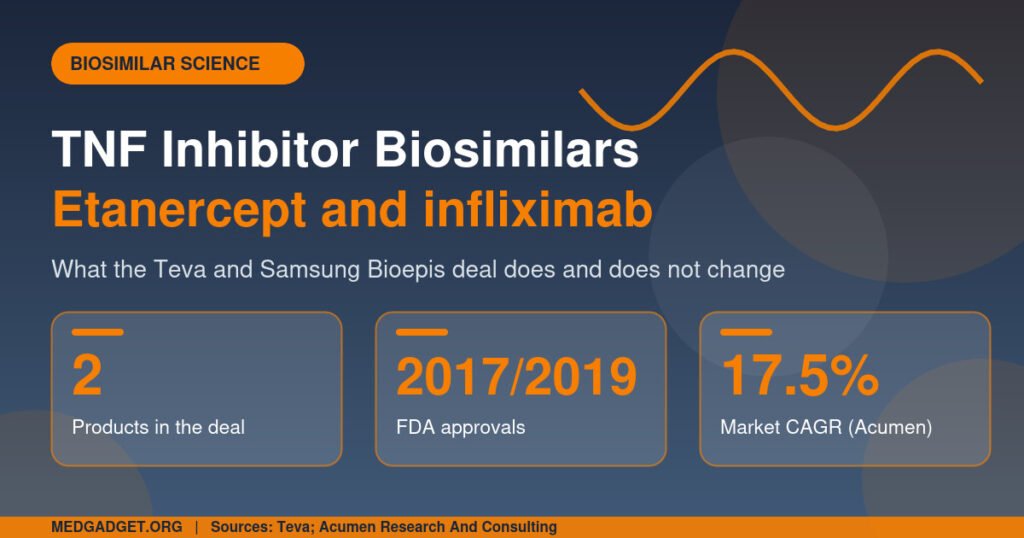
- Both are FDA-approved: infliximab-abda in 2017 and ETICOVO in 2019. The agreement is commercial, not regulatory.
- ETICOVO is not currently sold in the US; Teva gains US rights at closing, expected by the end of 2026.
- Infliximab-abda rights transfer to Teva in the third quarter of 2027.
- Samsung Bioepis keeps regulatory and manufacturing responsibility.
- Financial terms are undisclosed beyond an upfront payment over three years, possible milestones and a profit share.
What TNF inhibitors do
Tumour necrosis factor, or TNF, is a signalling protein that drives inflammation. In several immune-mediated inflammatory diseases, TNF activity is excessive, and drugs that block it can reduce symptoms and damage. Etanercept is a fusion protein that binds TNF, while infliximab is a monoclonal antibody that does the same through a different structure. They are administered differently, but they act on the same target. The announcement does not discuss clinical indications or dosing, so we stay at the level of mechanism.
How a biosimilar is shown to be similar
A biosimilar developer must demonstrate that its product is highly similar to the reference product, notwithstanding minor differences in clinically inactive components, and that there are no clinically meaningful differences in safety, purity and potency. In practice, this rests on a stepwise comparison: detailed analytical characterisation of structure and function, nonclinical data where needed, and clinical studies that address remaining uncertainty. Our description is general; the FDA biosimilars pages set out the agency’s approach in full.
An important consequence is that the approval decision for a biosimilar is made before commercialisation, and does not depend on who sells the product. That is why a change of commercial partner, as here, does not alter the underlying evidence package. It may still change practical matters such as supply, support services and contracting.
The products and the transfer schedule
| Product | Reference | FDA approval | Rights to Teva |
|---|---|---|---|
| ETICOVO (etanercept-ykro) | Enbrel | 2019 | At closing, expected by end-2026 |
| Infliximab-abda | Remicade | 2017 | Q3 2027 |
The release does not name a separate brand for infliximab-abda, and does not say who currently markets it in the US. We therefore make no statement about current market share or supply arrangements for either product.
Evidence questions a clinician or pharmacist might ask
The following list is our framing of questions, not claims from the companies.
- Interchangeability: whether either product holds an interchangeable designation is not stated in the announcement.
- Formulation and device: the release does not describe presentations, such as prefilled syringes or vials.
- Switching: any real-world experience with switching from the reference product is outside the scope of the announcement.
- Supply continuity: Samsung Bioepis remains the manufacturer, which suggests supply responsibility does not move, but this is our inference and not a stated guarantee.
Timeline
- 2017: the FDA approves infliximab-abda.
- 2019: the FDA approves ETICOVO.
- 2025: Teva and Samsung Bioepis bring EPYSQLI (eculizumab-aagh) to the US.
- 2026: collaboration expands to OPUVIZ (aflibercept) in Canada and a global deal on up to six early-stage candidates.
- 3 November 2026: US agreement on ETICOVO and infliximab-abda announced.
- Q3 2027: infliximab-abda US rights transfer.
Market context: biosimilars
According to Acumen Research And Consulting, the global biosimilars market was USD 26.7 billion in 2023 and is projected to reach USD 113.2 billion by 2032, a compound annual growth rate of 17.5% over 2024 to 2032. North America accounted for about USD 10.7 billion, Asia-Pacific is projected to grow at over 18.4%, and recombinant non-glycosylated proteins exceeded USD 14.4 billion.
The Acumen page shows an old last-updated date (August 2017) that conflicts with its 2023 base year and includes a stray heading from a different market. We treat the numbers as indicative. They cover all biosimilars and are not specific to TNF inhibitors, to Teva or to these two products.
Our analysis
In our assessment, the scientific substance of this story is limited, which is itself informative: nothing in the announcement changes the evidence behind either product. What changes is access, because ETICOVO has not been sold in the US and now has an experienced commercial partner. Readers who care about evidence should look for any future real-world data or comparative studies, and for the interchangeability status of each product, none of which the companies discussed.
What is not disclosed
- Financial terms: upfront amount, milestones and profit share.
- Launch date for ETICOVO.
- Brand name and current US marketer of infliximab-abda.
- Interchangeability designations and presentations.
- Conditions or timing of regulatory approvals needed to close.
Risks and caveats
- Closing is subject to customary conditions, including regulatory approvals.
- Market figures are third-party estimates with dating issues.
- The announcement is a company release; independent comment was not available to us.
- This is not medical advice; treatment decisions belong with clinicians.
What to watch next
- Confirmation of closing.
- ETICOVO launch timing.
- Any update on infliximab-abda before Q3 2027.
- Comparative or real-world evidence for TNF inhibitor biosimilars.
General background
The companies publish information at Teva and Samsung Bioepis. We have also covered Celltrion’s Omlyclo biosimilars and biosimilar pressure in Roche’s third-quarter results. More in the Pharmaceutical category.
Questions readers are asking about TNF inhibitor biosimilars
Are biosimilars the same as generics?
No. Biologics are made in living cells and cannot be copied exactly, so biosimilars must show high similarity through extensive comparison.
Did the FDA just approve these two products?
No. They were approved in 2017 and 2019.
Does a change of seller change the medicine?
The announcement says Samsung Bioepis remains responsible for manufacturing, so we have no indication that the product itself changes.
FAQ
What is etanercept?
A TNF-blocking fusion protein; ETICOVO is a biosimilar to Enbrel.
What is infliximab?
A TNF-blocking monoclonal antibody; infliximab-abda is a biosimilar to Remicade.
When does Teva take over?
ETICOVO at closing, expected by end-2026; infliximab-abda in Q3 2027.
How we reported this: details come from Teva’s announcement of 3 November 2026 and regulator information; market figures are attributed to Acumen Research And Consulting. Last updated 4 November 2026. This is news reporting and not medical advice.