
The evidence on renal denervation for hypertension grew on 3 November 2026, when investigators presented six-month results from SPYRAL AFFIRM, a real-world study of Medtronic’s Symplicity Spyral system. Office systolic blood pressure fell by an average of 18.2 mmHg, home and 24-hour readings fell by about 9 to 10 mmHg, and patients did not take more medication. Because the study is single-arm, the results need careful reading.
Key takeaways on renal denervation for hypertension from SPYRAL AFFIRM
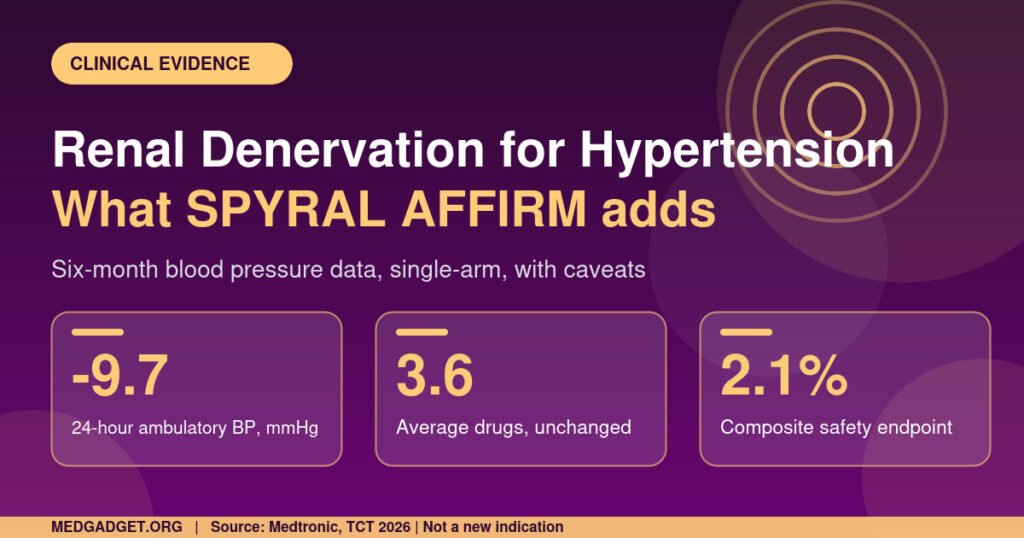
- Office systolic BP: -18.2 mmHg at six months; home BP: -9.4 mmHg; 24-hour ambulatory BP: -9.7 mmHg; all p below 0.0001.
- Medication count was unchanged at 3.6, and 51% of patients were on four or more drugs at baseline, according to a conference report.
- 86.1% of patients met at least one prespecified measure of clinical benefit, per the same report.
- Design: prospective, multicentre, single-arm post-approval study designed with the FDA.
- An FDA labelling update adds data in three patient groups but leaves the indication for use unchanged.
The physiology: how nerves around the kidney arteries influence blood pressure
The kidneys and the nerves that supply them help regulate blood pressure. Sympathetic nerves running along the renal arteries send signals that can raise blood pressure, by affecting kidney function, fluid balance and blood vessel tone. In renal denervation, a catheter delivers energy to these nerves from inside the artery, reducing the signalling. The aim is a lasting reduction in blood pressure without a drug or an implant. General background on hypertension is available from the American Heart Association.
What the six-month data show
| Measure | Result at six months | Context |
|---|---|---|
| Office systolic BP | -18.2 mmHg | Primary endpoint; baseline reported at conference as 169/106 mmHg |
| Home BP | -9.4 mmHg | Baseline reported as 158/101 mmHg |
| 24-hour ambulatory BP | -9.7 mmHg | Baseline reported as 151/96 mmHg |
| Clinical benefit responders | 86.1% | Office SBP down 10 or more, home SBP down 5 or more, or at least one fewer drug |
| Quality of life (EQ-5D-3L) | +2.7 points | Units and scale range not stated |
The ambulatory and home readings are smaller than the office reading, which is common: office readings tend to fall more than out-of-office readings. Evidence reviewers usually give more weight to 24-hour ambulatory measures because they are less affected by the clinic environment. The release does not specify whether the home and ambulatory figures are systolic.
Strengths of the evidence
- Breadth: the US cohort reportedly included 594 patients at 73 sites, a broad and diverse group including 27.1% Black and 10.6% Hispanic patients.
- Real-world setting: patients were treated in routine practice after approval, which is closer to how the device would be used than a tightly controlled trial.
- Medication stability: because the drug count did not change, the blood pressure fall cannot be explained by added medication.
- Consistency: investigators report similar reductions in women, older adults and patients with kidney disease or diabetes, though no numbers were given.
Limits of the evidence
- Single-arm design: with no sham or medication comparison group in the reported data, effects of regression to the mean and the placebo response cannot be separated from the procedure.
- Short follow-up: six months says little about durability or about outcomes such as stroke and heart attack.
- Source: the numbers are from the manufacturer and a conference report; the full paper in Circulation: Cardiovascular Interventions should be consulted.
- Safety data: Medtronic reports a composite safety endpoint of 2.1%, while the conference report says fewer than 1% had an adverse event; the two may measure different things.
Timeline
- 2026: a pooled analysis reported similar benefit at three years, cited by Medtronic.
- 3 November 2026: six-month SPYRAL AFFIRM data presented at TCT and published.
- Same period: the FDA labelling update, date not stated.
What the FDA labelling update means
The update adds data for isolated systolic hypertension, chronic kidney disease up to stage 3b and type 2 diabetes to the Symplicity Spyral catheter’s labelling. Medtronic says the indication for use is unchanged. In practical terms, clinicians and patients in these groups now have more specific evidence in the product information, but the approved use of the device has not been widened. Official information is at the FDA medical devices pages.
Expert views
Lead investigator David Kandzari of Piedmont Heart Institute said the reductions are transformative, and also said renal denervation is not currently endorsed as primary therapy and may help most when combined with lifestyle change and medicines. Lead discussant Clyde Yancy of Northwestern Memorial Hospital praised the more complex, real-world patient profile and asked whether renal denervation should be considered a primary intervention rather than an adjunct. Kandzari reports institutional research support from several device companies, including Medtronic.
Market context: renal denervation
According to Acumen Research And Consulting, the global renal denervation market was USD 198.1 million in 2021 and is projected to reach USD 4,464.6 million by 2030, a compound annual growth rate of 41.5%. Europe held over 70% share in 2021 and Symplicity held over 45% of the market. The page is dated October 2022, the stated growth rate fits a nine-year period from 2021 rather than the named 2022 to 2030 period, and it cites an implausible hypertension prevalence. We treat it as a dated projection.
Our analysis
In our assessment, SPYRAL AFFIRM is valuable because it shows what happens in an unselected, diverse, real-world population, and a blood pressure fall of this size without extra drugs is clinically meaningful. It does not settle the questions that a randomised sham-controlled comparison would, or those that long-term outcome data would. The sensible reading is that the study adds supportive evidence rather than overturning the view that renal denervation is an option for selected patients.
What is not disclosed
- The prespecified performance goal and the result against it.
- Numerical subgroup results.
- The date of the FDA labelling approval.
- A full adverse-event breakdown.
Risks and caveats
- Results are from a single-arm study at six months.
- Some numbers come from a conference report, not the company release.
- The labelling update does not add an indication.
- This article is not medical advice.
What to watch next
- Longer follow-up and outcomes data.
- Controlled comparisons with medicines or sham procedures.
- Guideline and coverage decisions.
- The published paper’s details on safety.
General background
Medtronic’s own information is on its website. We also cover the company in our report on the Simplera Sync sensor launch and the CoreMap funding round it led. More device news is in our Medical Device section.
Questions readers are asking about renal denervation for hypertension
Does renal denervation cure high blood pressure?
No. The study reports reductions in blood pressure, not a cure, and patients continued to take medication.
How large was the fall in blood pressure?
18.2 mmHg in office systolic pressure on average at six months.
Why does the study design matter?
Because it is single-arm, the effect of the procedure cannot be fully separated from other factors.
FAQ
What does EQ-5D measure?
Health-related quality of life; the article does not state the scale range.
Is a device implanted?
No implant is left behind; energy is delivered during a catheter procedure.
Who should consider it?
That is a decision for a doctor, based on blood pressure history, medications and other conditions.
How we reported this: details come from Medtronic’s announcement of 3 November 2026 and a conference report on the presentation; market figures are attributed to Acumen Research And Consulting. Last updated 4 November 2026. This is news reporting and not medical advice.