
A trial can win on its most important endpoint and still miss another. The AstraZeneca stomach cancer drug trial is that kind of result: sonesitatug vedotin, an experimental claudin 18.2 antibody-drug conjugate, showed a statistically significant survival benefit, yet progression-free survival by independent review gave a p-value of 0.053, just short of significance. This article explains how to read both results, using the figures presented at ESMO 2026 on 25 October. The drug is investigational.
Key takeaways: the AstraZeneca stomach cancer drug trial and its missed endpoint
- Overall survival in third-line-and-later patients (a primary endpoint): 10.0 versus 5.0 months, hazard ratio 0.47, a 53% lower risk of death.
- Overall survival in second-line-and-later patients (key secondary): 10.6 versus 6.4 months, hazard ratio 0.58, 42% lower risk.
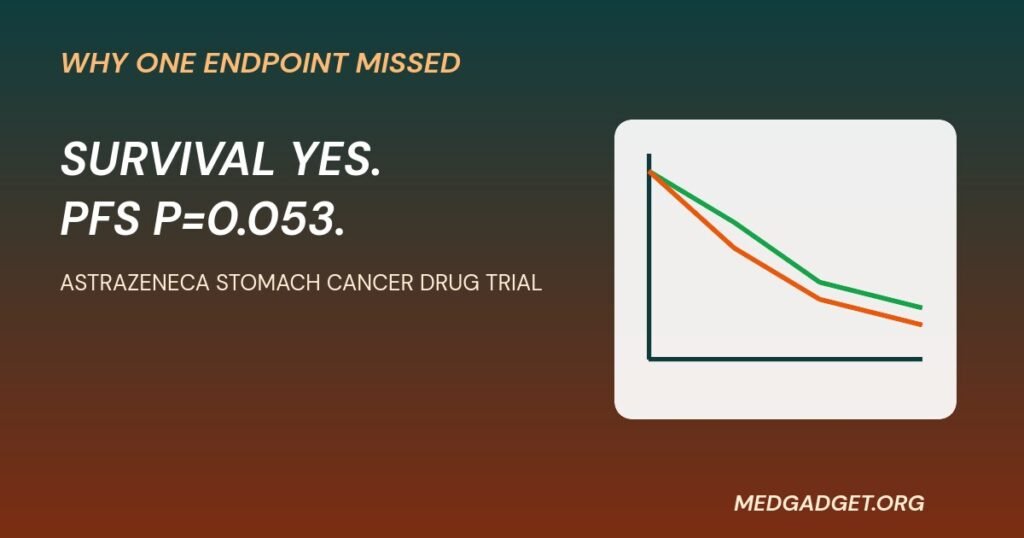
- Progression-free survival by blinded review (a primary endpoint): 4.2 versus 3.8 months, hazard ratio 0.77, p=0.053, not significant.
- Investigator-assessed progression-free survival, an exploratory analysis, was 4.4 versus 3.0 months (hazard ratio 0.59).
- The brief’s 532 patients are the second-line-and-later population, not the third-line group.
How the AstraZeneca stomach cancer drug trial was built
CLARITY-Gastric01 (NCT06346392) had two stages. In the first, patients were randomised to Sone-Ve at 2.2 mg/kg, Sone-Ve at 1.8 mg/kg or investigator’s choice of therapy, all given every three weeks. In the second, 2.2 mg/kg was used as the recommended dose. A trade report puts total enrolment at about 594 patients at 175 centres in 19 countries; the analyses reported here are based on 532 patients in the second-line-and-later population. The registry is at ClinicalTrials.gov.
Eligible patients had adenocarcinoma of the stomach, gastroesophageal junction or oesophagus with claudin 18.2 expression in at least 25% of tumour cells, measured with a companion assay. The study was described as open-label and sponsor-blinded.
Two primary endpoints in the AstraZeneca stomach cancer drug trial
The trial had dual primary endpoints. The first was overall survival in the third-line-and-later group, which was met. The second was progression-free survival by blinded independent central review in the overall population, which showed a trend but did not reach statistical significance. A third result, overall survival in the second-line-and-later population, was a key secondary endpoint and was statistically significant.
A p-value of 0.053 is close to, but not under, the 0.05 threshold. It is not evidence that the drug does not delay progression, and it is also not evidence that it does. The confidence interval for the hazard ratio (0.62 to 0.96) lies below 1, which sits oddly beside the p-value; the sources do not explain the difference in method, so we report both as published.
What the survival data show in the AstraZeneca stomach cancer drug trial
- Third line and later (178 versus 177 patients, our sum 355): median 10.0 months (95% CI 7.2 to 11.4) versus 5.0 months (95% CI 4.2 to 6.4). Twelve-month survival 38.1% versus 18.1%.
- Second line and later (267 versus 265, total 532): median 10.6 months (95% CI 9.1 to 12.0) versus 6.4 months (95% CI 5.8 to 7.6). Twelve-month survival 42.6% versus 27.8%.
Survival is not affected by how often scans are done or how progression is judged, so it is the harder endpoint to dispute. The hazard ratio was similar across claudin 18.2 levels: 0.59 where 75% or more of cells were positive and 0.63 in the 25% to under 75% group.
Safety and tolerability in the AstraZeneca stomach cancer drug trial
Grade 3 or higher treatment-related adverse events were 36.4% on Sone-Ve versus 44.8% on comparator. AstraZeneca reports no new safety signals. Sone-Ve carries the payload monomethyl auristatin E, and the sources do not give rates of individual side effects, so we cannot discuss specific toxicities.
Market context by region for the AstraZeneca stomach cancer drug trial
Acumen Research and Consulting’s report Antibody Drug Conjugate Market Size, Share, Analysis, Trends and Forecast 2024 to 2032 puts North America at about USD 5.35 billion of the global antibody-drug conjugate market in 2023, roughly 52% by our own calculation from the USD 10.3 billion total, and says Asia Pacific is expected to grow fastest at more than 14% a year from 2024 to 2032. It reports that cleavable linkers held 72% of the market in 2023; Sone-Ve uses a protease-degradable linker, which is a cleavable type. The page’s updated date is inconsistent with its forecast period, so use the figures as estimates. See our Pharmaceutical section.
General background: why regulators look at both endpoints
Trials with two primary endpoints are designed so that the sponsor can claim success if either is met, but regulators also look at the overall picture. A large survival gain with a borderline progression result can support approval if the benefit is consistent and safety is acceptable. Orphan Drug Designation from the US FDA and the European Commission, and Breakthrough Designation in China, are already in place for Sone-Ve, according to the company.
Our analysis of the AstraZeneca stomach cancer drug trial
In our assessment, the AstraZeneca stomach cancer drug trial delivers a convincing survival result in a setting where median survival is measured in months, while a missed progression endpoint makes the dossier less clean than it could have been. The open-label design is the main bias concern for progression, which is judged by scans and investigators. We do not predict how regulators will weigh the results.
What is not disclosed about the AstraZeneca stomach cancer drug trial
- Response rates and duration of response.
- Rates of specific adverse events.
- Filing timelines.
- Which comparator therapies patients received.
Risks and caveats of the AstraZeneca stomach cancer drug trial
The drug is investigational and not approved. Figures come from the company release and congress presentation as reported. The progression-free survival endpoint was not statistically significant. Acumen estimates are broad. This is news reporting and not medical advice.
What to watch next after the AstraZeneca stomach cancer drug trial
- Regulatory filings and decisions.
- Full publication of the results.
- Final survival analysis.
- Earlier-line trials.
FAQ
Did the AstraZeneca stomach cancer drug trial meet its primary endpoints?
It met the third-line overall survival endpoint. Progression-free survival by blinded review did not reach significance (p=0.053).
Why do the brief and the company numbers differ?
The 532 patients and 42% reduction belong to the second-line-and-later group; 10 versus 5 months and 53% belong to the third-line-and-later subgroup.
Is it approved?
No. It is investigational.
How we reported this: we relied on the AstraZeneca announcement and ESMO presentation as reported, the trial registry and the Acumen Research and Consulting report cited above, and attributed every claim. Last updated 26 October 2026. This is news reporting and not advice.